When the Rhino Times warned people that their housing values could go up by 50 percent or more in the new revaluation, it turns out that warning wasn’t anywhere near strong enough for a lot of homeowners in the county.
County tax officials have previously told the Board of Commissioners that overall property values were expected to rise roughly 40 to 45 percent on average compared to the 2022 revaluation.
However, they also told the Rhino Times that housing was one of the property sectors where the largest increases would occur. So, it was fairly evident that home values would likely go up 50 percent or more.
Guilford County Tax Director Ben Chavis told the Rhino Times on Tuesday, Feb. 17 – the day the new numbers were posted online – that the department hasn’t published any summary information on the revaluation now that it is done.
However, spot checks by the Rhino Times of new housing values seem to indicate that homes are coming in much higher than 50 percent in many cases and that, in some cases, even coming in at two and a half times what they were in the previous 2022 revaluation.
Checks of individual parcels show that results vary widely – and in some cases dramatically.
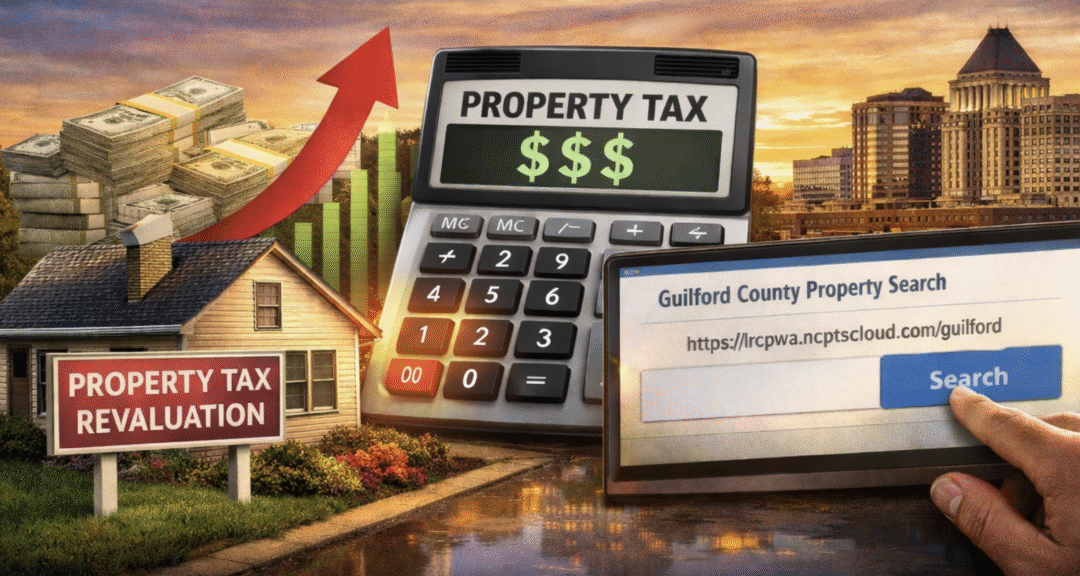
If you’re a Guilford County homeowner, you can now check your new 2026 assessed property value by visiting the Guilford County Tax Department’s online property search portal at https://lrcpwa.ncptscloud.com/guilford/.
Some homeowners may want to grab a drink, sit down and take a deep breath before they do.
In one instance reviewed by the Rhino Times, a small house on Boone Street in Greensboro that was valued at $49,200 in the 2022 revaluation is now listed at $118,000 for 2026. That’s an increase of nearly 140 percent – meaning the new value is almost two and a half times higher than the previous assessment.
The home hasn’t been expanded or significantly upgraded since the last revaluation. No deluxe swimming pool was added or anything. The sharp jump appears to merely reflect market changes rather than physical improvements to the structure.
Other properties spot checked show increases in the 55 to 65 percent range – well above the overall average that county officials have discussed publicly – though far below the most extreme examples.
Lower-valued homes often show the largest percentage swings when markets rise quickly, as the Guilford County housing market has done in recent years.
A $50,000 property that rises to $120,000 produces a much larger percentage increase than a $300,000 home that rises to $360,000 – even if the dollar gains are similar. That mathematical reality can make increases in modest neighborhoods especially dramatic.
Those same lower-valued properties are frequently owned by residents with fewer financial resources, meaning even revenue-neutral tax shifts – good luck with that this year – can be particularly burdensome.
Homeowners who believe their new assessed value exceeds fair market value have the right to appeal. The first step is typically an informal review with the Tax Department, where property owners can present comparable sales or point out factual errors in square footage, condition or other characteristics. If the issue isn’t resolved at that point, owners may appeal to the Board of Equalization and Review within the deadline set by the county.
The Guilford County Board of Commissioners will set a new tax rate in June in light of the revaluation. The last time the Democratic-majority board oversaw a reval – in 2022 – the board kept the tax rate the same and raked in roughly $92 million in extra taxpayer money year after year.
State law requires the county to calculate a revenue-neutral rate that would generate the same overall property tax revenue as before. However, it’s the commissioners who decide where to set the tax rate.
Given some of the numbers coming in, it’s very hard to imagine that even this Board of Commissioners will not come down at least somewhat on the tax rate, though revenue neutral is a pipe dream. If the tax rate is left where it is, then some of the people who can least afford it could see their property tax bill double or even triple.
Revenue neutrality only applies to the county as a whole – not to individual parcels. So, some homeowners will see decreases, some modest increases and others much larger shifts depending on how their property values changed relative to the broader tax base.
For many residents, the numbers now posted online offer the first concrete look at just how much the local housing market has changed since the last countywide revaluation.