


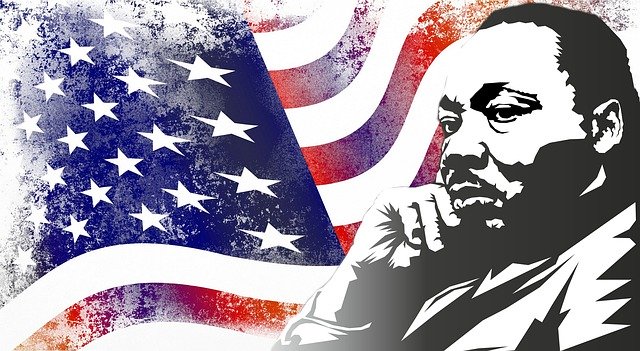
The 36th Annual Greensboro NAACP Martin Luther King Jr. Day Parade will take place Monday, Jan. 19, from 11 a.m. to 1 p.m., continuing a tradition that traces directly back to the renaming of one of Greensboro’s major thoroughfares more than three decades ago.
The parade is sponsored by the Greensboro Branch of the NAACP and will once again travel, of course, along Martin Luther King Jr. Drive – a street whose name, and the parade itself, exist largely because of the persistence of Chairman of the Guilford County Board of Commissioners Skip Alston.
This year’s honorary grand marshals are Bishop Bryan J. Pierce Sr. and First Lady Debra A. Pierce of Mount Zion Baptist Church of Greensboro. The grand marshals are Denise Roth, Greensboro mayor pro tem, and Frankie Jones Jr., the Guilford County commissioner representing District 7 until the end of this year.
Lineup for the parade will begin at 10 a.m. at the Benbow Professional Building at 2031 Martin Luther King Jr. Drive. Participation in the parade is free for nonprofit organizations and church groups, while businesses and political candidates are charged a $75 fee.
Those interested in registering can call Gwendolyn Alston at (336) 327-9148.
While most people know the story of Martin Luther King Jr., fewer know how Greensboro’s parade came to exist – or how close the city came to never having a street named after King at all.
According to Alston, the very first parade in 1990 was never intended to launch an annual event. It was instead organized simply to mark the city’s 1989 decision to rename Asheboro Street as Martin Luther King Jr. Drive.
Alston said the idea was sparked after he attended a street-naming ceremony for King in Atlanta in 1988. As he listened to people talk about taking the idea back to their own cities, he left feeling determined to do the same in Greensboro.
His first stop was the Greensboro Planning Board.
“I got voted down 8-to-1,” Alston said.
Even more surprising to him was that the head of the Greensboro chapter of the NAACP at the time voted against the proposal. Alston noted that the board member had defeated him in a race the year before to become head of the local NAACP, which Alston believed may have played a role in that no vote.
After the Planning Board rejection, Alston took the idea to the Greensboro City Council, where he was told to gather signatures.
“I walked the street myself,” he said.
One encounter during that process stayed with him: An elderly Black woman in her 80s told him she would sign the petition, but doubted the effort would succeed.
“I’ll sign your petition – but those white people are never going to name the street after a black man,” she told him.
Alston said he promised her that, if she signed, he’d do everything in his power to make the change happen.
Choosing Asheboro Street was deliberate: Alston said he wanted a long street that connected to major highways so motorists would see exit signs bearing King’s name.
He also noted the street’s history – from the 1890s through the 1920s, it had been home to some of Greensboro’s wealthiest residents, many of whom lived in large houses along the corridor.
Alston originally wanted the street named Martin Luther King Jr. Boulevard, however, one City Council member raised concerns that “boulevard” implied a wide, multi-lane road.
“He said this was more of a ‘Drive,’” Alston recalled.
Alston told the City Council members he didn’t care what it was called, as long as it carried King’s name.
When the first parade took place in 1990, Alston said the weather was unseasonably warm and an estimated 30,000 people turned out.
Once it was over, people immediately began asking about the next parade.
“Next parade?” he remembered thinking.
The amount of work involved in organizing the first event made him reluctant to repeat it, but community support kept growing. What was meant to be a one-time celebration turned into an annual tradition that has continued for more than three decades and keeps getting bigger.
In that same year, Alston also organized a Sunday afternoon gospel celebration held the day before the parade, another event that has endured alongside the march itself.
What began as a fight to rename a street has become a fixture of Greensboro’s civic calendar, with the annual parade serving as both a celebration of Martin Luther King Jr.’s legacy and a reminder of the local effort that made the street – and the parade that runs down it – possible.
There are also many other events in Guilford County celebrating King’s life. A list of other festivities and remembrances can be found here: https://www.peacemakeronline.com/stories/upcoming-2026-dr-martin-luther-king-jr-celebrations,90493




.
Does Skippy ever do anything for white people? Or ALL the citizens?
Al Really hard to stop laughing at that one. Thanks for the chuckles
Nope. Racist
Skip is a racist communist.
Skippy is the most racist person in Guilford County! He absolutely hates white people and makes no bones about it. He will never do anything for the white citizens of Guilford county. He only picked Asheboro Street to rename MLK drive because it was all black people and he was able to con them to his way of thinking. He uses his own race of people and they don’t even realize it. They are padding his pockets and he’s laughing all the way to the bank.
Alston is a racist
✔️
I think MLK was a great American. Listen to his speech in Washington.
But, my bank was closed today…………
Can you name another person the banks close for?
Jesus Christ.
I stand corrected!
score! but . . . the romans crucified thousands & . . . how did the ‘holy’ family invest the gifts to ‘god’ from three kings ? crypto ?
Washington’s birthday (Presidents Day)
Columbus
Jesus Christ
Amazing how people’s bigotry blinds them from even common knowledge.
I am 65 and lived in Greensboro all of my life. It is sad to see the millions of dollars the city has pumped into the Asheboro street area, nothing has changed in that area, just the next generation of drug dealers and hookers.
Like putting perfume on a pig……..