


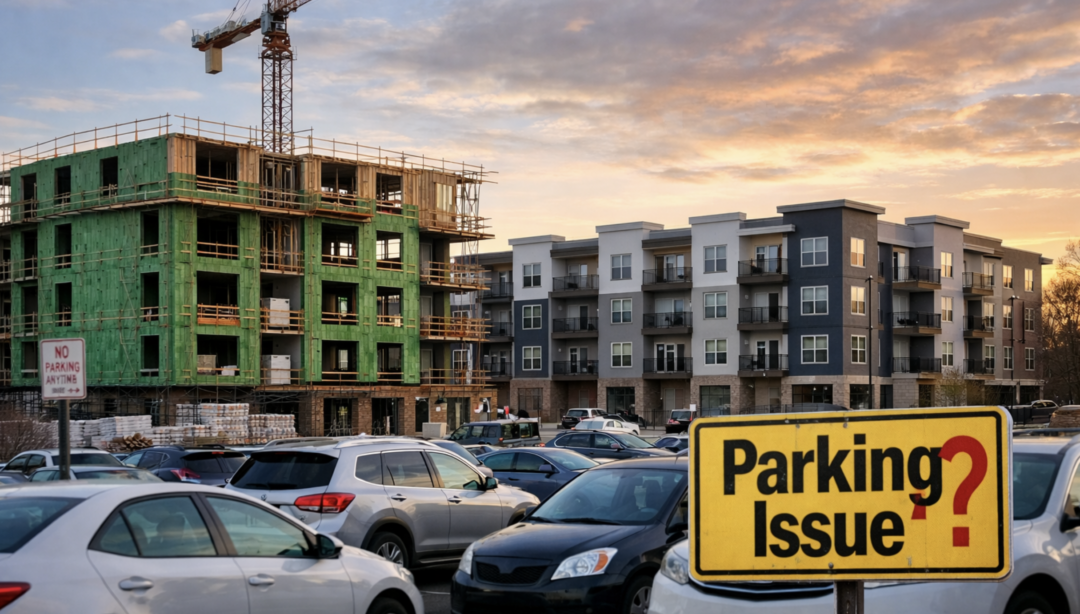
The Guilford County Board of Commissioners is set to consider a change this week that could quietly reshape how future housing developments are built – and how easy it is to find a parking space once they are.
At its Thursday, April 2 meeting, the Guilford County Board of Commissioners will hold a legislative hearing on a proposed amendment to the county’s Unified Development Ordinance (UDO) that would reduce minimum parking requirements for multi-family housing and townhomes.
These types of changes typically move forward with little to no opposition so, while there will be a required public hearing, it’s very rare for people to speak at these types of hearings and the commissioners generally vote unanimously to make the changes suggested by county staff.
The change may sound technical, but it has real-world implications – especially in a county already dealing with a whole lot of growth, a lot of new apartment construction and increasing concerns about parking in some areas.
Under the current rules, most multi-family developments are required to provide about 1.8 parking spaces per unit – plus additional spaces for visitors. The proposed amendment replaces that one-size-fits-all approach with a sliding scale based on the number of bedrooms.
After approval, developers would only be required to provide:
- 1.25 spaces for units with zero or one bedroom
- 1.5 spaces for two-bedroom units
- 2.0 spaces for units with three or more bedrooms
County staff say the change better reflects how parking is actually used, since smaller units typically house fewer people and fewer vehicles.
But the bigger impact is what happens when those requirements go down. Less required parking means developers can build less pavement – which lowers construction costs and makes it easier to fit more units onto a site.
It also frees up space that can be used for additional housing, green space or other amenities.
That’s one of the main justifications that county staff point to.
According to the staff report in the agenda materials for the board’s Thursday meeting, reducing parking requirements can help limit impervious surfaces – the paved areas that contribute to stormwater runoff – and improve watershed health by allowing more open space and green infrastructure.
In other words: fewer parking lots, less runoff and potentially more environmentally friendly development.
However, while that may check the box for long-term planning goals, it also raises a more immediate question for county residents: Where will people park?
Anyone who’s spent time in parts of Greensboro where apartment construction has picked up in recent years knows that parking there can already be tight – especially in older developments or areas where multiple households rely on street parking.
Lowering the number of required spaces doesn’t mean fewer cars. It just means fewer guaranteed places to put them.
That tension – between encouraging development and maintaining quality of life – is at the center of the debate, even if it isn’t explicitly stated in the staff report.
The Guilford County Planning Board unanimously recommended approval of the amendment at its February meeting.
After the commissioners adopt the change, it will apply to future townhouse and multi-family developments across the county, shaping how new housing is designed going forward.
The parking amendment is one of several UDO changes on the commissioners’ agenda Thursday night, most of which are far more technical.
Among them is a separate proposal that would remove limits on how often developers can refile rezoning requests on the same property – a change required under recent state law that eliminates waiting periods and caps on repeated applications.
That measure would allow developers to bring projects back for reconsideration more quickly, even after being denied. With ongoing housing demand and large expected population growth, county leaders are trying to make it easier and faster for developers to put up new housing.
While that change affects the development process behind the scenes, the parking amendment is the one most likely to be noticed by residents. Because, when it comes to growth, density and development, few issues hit closer to home than whether there’s a place to park when you get there.




————-
Just another example of them making life harder for motorists, and the private automobile.
Much more to come.