

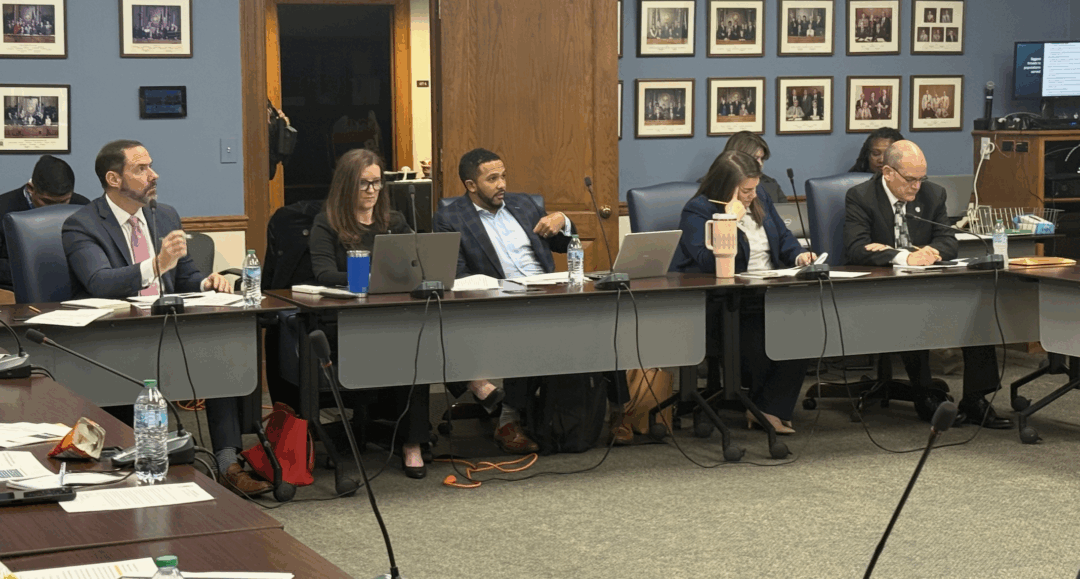
Guilford County commissioners spent a whole lot of time in their Thursday, Dec. 4 work session debating not only how to divide a proposed quarter-cent sales tax, but also how to present that tax to the public.
The board is preparing for a 2026 referendum on what’s formally known as an Article 46 sales tax, and county commissioners said the wording that voters see in the booth could make or break the measure’s chances.
At the center of the discussion was a presentation by Guilford County Budget Director Toy Beeninga, an excellent public speaker who walked commissioners through the mechanics of House Bill 305 – a new state law that outlines how Guilford County must structure a sales tax referendum planned for 2026.
The bill was passed earlier this year and spells out exactly how any new revenue must be allocated if voters approve it. The commissioners, however, have a chance to work with state legislators and tweak the language that will appear on the ballot in November of 2026.
As of now, here it is:
“[ ] FOR [ ] AGAINST
Local sales and use tax at the rate of one-quarter of one percent (0.25%) in addition to all other State and local sales and use taxes to be used solely for classroom teacher salary supplements, fire protection equipment and services, for Guilford Technical Community College, and to be used by municipalities for any public purpose.”
This is the exact statutory wording that must appear on the referendum unless the legislature amends it.
It uses the phrase “one-quarter of one percent (0.25%),” which many commissioners want rewritten.
Guilford County is asking the legislature to consider revising the current ballot language for clarity; however, unless lawmakers approve changes, the above wording is what will appear on the 2026 ballot.
According to Beeninga, the tax would raise an estimated $28.7 million a year, with roughly 67 percent going to classroom teacher salary supplements, 19 percent to fire protection equipment and services, and 9 percent to capital improvements at Guilford Technical Community College.
A final 5 percent would be distributed to smaller municipalities according to a formula based on population and property tax base.
Beeninga noted that, if voters approve the measure in the fall of 2026, Guilford County teachers would instantly jump from 16th to about 6th in North Carolina when it comes to average local salary supplements. GTCC would gain funding for facility renovations and expansions meant to align with aerospace and advanced manufacturing training demands.
And rural fire districts would finally have a recurring revenue stream to replace aging fire trucks and equipment – something Guilford County officials have been concerned about for years.
Commissioner Alan Perdue, a former county emergency services director, pushed for simplifying the language as much as possible – arguing that voters shouldn’t be confronted with a long technical description when all they want is a clear choice.
Other commissioners had similar concerns.
Commissioner Frankie Jones pointed out that some of the minimum funding thresholds written into the bill mean certain percentage descriptions aren’t technically exact each year, which could create confusion.
One area of near-unanimous agreement was in avoiding the phrase “quarter-cent sales tax.”
Several commissioners said that phrase sounds like “a quarter” – “a higher number”– even though the tax is actually one-fourth of one percent. Some suggested that the ballot language say “one-fourth of one cent,” or “one-fourth of one penny.”
That phrasing immediately drew laughter and support.
“Love it,” one commissioner said during the discussion.
The idea is that county voters might react differently depending on whether the language evokes a single penny or something larger.
Chairman of the Guilford County Board of Commissioners Skip Alston asked the most practical question of the day – who exactly they needed to satisfy with all these edits.
Toy confirmed that the commissioners could propose changes, but the maker of the bill in the General Assembly would have to approve any revised ballot text before it could appear in 2026.
The board also spent time disentangling House Bill 305’s “supplanting” restrictions – rules that require the county, school system and GTCC to use the new sales tax money to supplement, not replace, existing funding.
Beeninga walked commissioners through a tangle of 10-year look-back formulas that determine how much each party must continue spending on teacher supplements, fire protection, and GTCC capital improvements. The original bill tried to apply all supplanting rules directly to the Board of Commissioners; however, the budget director explained that wasn’t workable in some cases. The county cannot directly appropriate funds for teacher supplements, for instance, because state law requires commissioners to allocate money to the school system at the purpose-level rather than the line-item level.
He recommended shifting the responsibility for maintaining teacher supplement funding levels to the Board of Education instead.
The Fire and Rescue Council, which includes both Greensboro and High Point, along with rural fire districts, is also asking for the county to establish a custodial fund to hold the new tax revenues.
Under that model, Guilford County would manage the money, invest it, and release it to the council upon request.
The council also asked for permission to spend up to 2 percent of its allocation – roughly $100,000 – on administrative costs, such as hiring an auditor or contract staff. Beeninga said the council’s current funding system, which relies on a nominal membership fee, isn’t enough to manage millions of dollars in annual sales tax revenue.
The commissioners plan to continue refining the language and allocations before sending it back to Raleigh. The referendum is expected to appear on the Tuesday, Nov. 3, 2026, ballot, with revenue collections beginning April 1, 2027 if voters approve it.
Beeninga emphasized that staff will develop educational materials but must avoid anything that looks like advocacy. State law allows counties to explain a referendum, but not to promote it.
In the past, when it came to sales tax referendums and “educating” the public about them, the county has played fast and loose with that rule and presented the public with some highly flattering information about how great it would be to have the additional $29 million or so in revenue from higher sales taxes.
What happens now is a months-long negotiation between Guilford County and the NC General Assembly over commas, percentages, and even word choice. However, based on this week’s discussion, the commissioners believe that the right phrasing – or the wrong one – could determine whether voters say yes to a tax increase that they argue would be small in size but large in impact.




This needs to be a hard No. The commissioners need to stop spending money like a drunken sailor on all their pet projects before we trust them with more of our money.