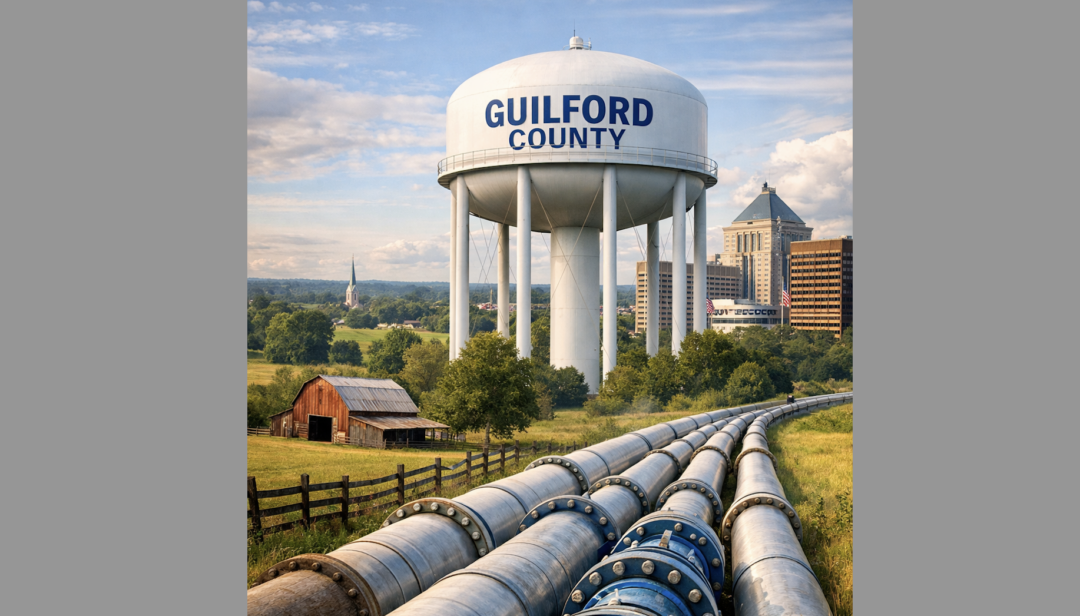
The Guilford County Board of Commissioners is expected to lend its formal support this week to a regional water planning effort that local leaders say will be critical to managing the Piedmont Triad’s rapid growth in the coming decades.
At their Thursday, March 19 meeting, the commissioners are scheduled to adopt a resolution backing a newly completed Master Planning Study by the Piedmont Triad Regional Water Authority (PTRWA).
The item appears on the board’s consent agenda for the meeting – a list of routine measures that are typically approved together without discussion.
The resolution expresses the county’s support for the authority’s long-term planning work and for its recommendation that the region move forward with developing additional wastewater capacity through a coordinated regional approach.
According to the resolution, the Piedmont Triad Regional Water Authority “has a longstanding commitment to providing reliable, high-quality water services to its member communities” and has played an important role in supporting “economic growth and environmental stewardship across the Piedmont Triad region.”
The measure further notes that the authority has been studying how the region can expand water and wastewater capacity to meet future demand.
“In 2023, PTRWA assembled an exploratory committee to look at regional water and wastewater capacity development,” the resolution states.
It goes on to explain that, in 2024, the authority completed a strategic plan aimed at establishing the organization as a regional utility capable of coordinating both water and wastewater services across Guilford and Randolph counties.
The resolution to be adopted also states that the authority has developed a business case for expanding its regional capacity portfolio and that further feasibility work will be required before specific projects move forward.
The Board of Commissioners’ action doesn’t commit Guilford County to any particular construction project or funding plan right now. Instead, the resolution is primarily a statement of support for the authority’s planning work and its role in evaluating potential regional solutions.
The measure concludes that the county board “affirms the county’s ongoing commitment to PTRWA’s leadership role and capability to prioritize and fully evaluate recommended regional utility capacity development alternatives.”
The item is sponsored by Commissioner Kay Cashion.
While the resolution itself is brief, the broader issue of water and wastewater capacity has been the subject of intense discussion among local leaders for several years.
In November 2025, county commissioners held a lengthy work session on the topic in the Carolyn Coleman conference room in the Old Guilford County Court House.
At that meeting, Gregory Flory, the executive director of the Piedmont Triad Regional Water Authority, walked the board through a regional master planning effort that looked at water and sewer needs through the year 2050.
Flory’s message to commissioners at the time was straightforward: The scale of infrastructure required to support future growth will be too large for any single city or town to handle alone.
Instead, he told the county leaders, the region will have to work together.
The Piedmont Triad has already seen a surge of economic development in recent years, including major industrial projects such as the $14 billion Toyota battery plant just across the Guilford-Randolph County line.
At the same time, residential growth continues across the county, with new subdivisions and commercial development steadily increasing demand on existing utilities.
Consultants who briefed the commissioners back in November warned that the county’s current infrastructure – along with a patchwork of decades-old agreements among local governments – won’t be sufficient to meet projected needs.
They also noted that new federal regulations targeting contaminants such as PFAS and dioxane could require expensive upgrades to water treatment systems.
Those regulatory changes could add hundreds of millions of dollars in costs for treatment technology.
Regional cooperation, the presenters argued, could dramatically reduce those costs by spreading them across a larger customer base.
The Piedmont Triad Regional Water Authority was created in 1986 and currently operates the Randleman Lake system.
The authority currently has a water treatment capacity of just under 15 million gallons a day – although an expansion project that’s now underway is expected to raise that capacity to roughly 26.7 million gallons per day.
But even that increase may not be enough to meet long-term demand.
During the November briefing, Flory told commissioners that the region might eventually face difficult choices if additional capacity isn’t developed.
Commissioner Pat Tillman at that meeting noted that without adequate water and sewer infrastructure, the region could find itself unable to accommodate future large-scale employers. Turning away a major project because of water limitations, he said, would be a serious economic setback.
At the same time, water expansion projects are often politically sensitive in Guilford County.
Some residents – particularly in more rural communities – worry that extending water lines will accelerate development and change the character of their areas.
In places like Summerfield, concerns about water systems have been raised repeatedly in local debates.
Former Summerfield Mayor Gail Dunham and others have argued that large-scale water expansion could threaten existing well systems and encourage unwanted development.
Many residents in rural parts of the county also say they prefer the slower pace and lower density that comes with relying on private wells rather than municipal utilities.
Supporters of regional planning, however, say that a coordinated approach is the only realistic way to handle the region’s growth while keeping water bills manageable. Smaller utilities often lack the customer base needed to fund major infrastructure upgrades on their own.
Leaders at the state level have also been encouraging regional approaches to water planning rather than piecemeal systems operated by small individual communities.
Thursday’s resolution doesn’t settle those debates, but it does signal that Guilford County’s commissioners intend to remain involved in the regional planning effort as it moves forward.
In the coming months, the Piedmont Triad Regional Water Authority is expected to continue refining its master plan and evaluating specific alternatives for expanding water and wastewater capacity across the region.