


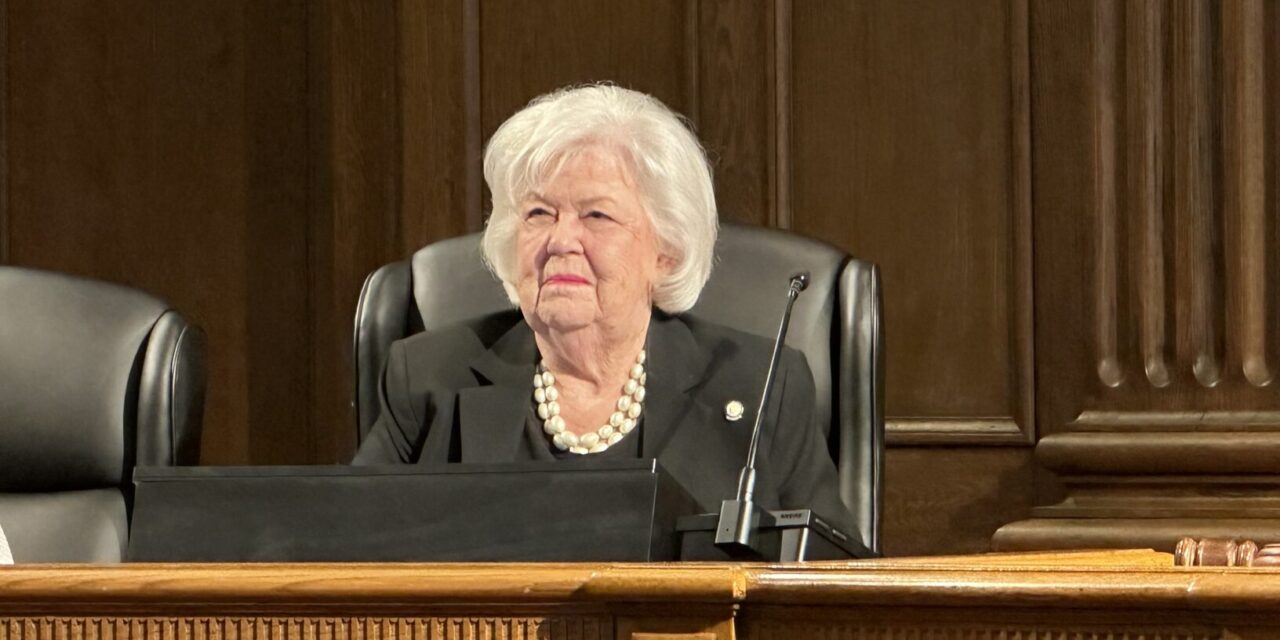
After more than two decades on the Guilford County Board of Commissioners, Kay Cashion has decided not to seek another term – which will end one of the longest and most influential tenures in modern Guilford County government.
The filing period for the 2026 election has closed and Cashion’s name isn’t on the list of candidates.
In December of 2026, her decision will mark the end of a career that began in the early 2000s and spanned more than 20 years of county history that saw changing county government priorities and major institutional and economic growth for the county.
Cashion was first appointed to the Board of Commissioners in 2004 after former Commissioner Jeff Thigpen, a Democrat, won a lucrative job as the Guilford County register of deeds. For much of her time on the board, she’s been in the board’s at-large seat, which has required her to appeal to voters across Guilford County rather than a single district.
She would go on to be re-elected repeatedly.
With Cashion opting not to seek re-election in 2026, four candidates have filed to run for her seat on the board.
Three Democrats filed for the at-large seat and will face each other in the March primary: Greg Drumwright, who lives in Greensboro; Amy Kemp, also of Greensboro; and Toby Andrea Hedgepeth, who lives in Whitsett.
One Republican, Tony Jacobelli, has filed for the at-large seat. Jacobelli lives in Gibsonville and will advance directly to the November general election.
Because Guilford County is heavily Democratic, the winner of the Democratic primary is usually the front-runner in the general election.
Before entering public office, Cashion was already well known in the Greensboro business community. She owned and operated a home furnishings store and decorating business for decades, and she built a reputation as a small-business owner who understands firsthand the pressures facing local merchants.
That business background shaped her approach as a commissioner, particularly on issues involving economic development, workforce concerns and the practical effects of county regulations.
For instance, when the board began giving county employees more and more time off, she spoke up and asked if there would be any workers left to conduct county business.
During her time on the board, Cashion developed a reputation as a commissioner highly engaged with social services, public safety and justice-related issues. She has a strong advocate for programs designed to protect vulnerable residents, particularly victims of domestic violence and abuse, and consistently supported efforts to coordinate services across county departments and nonprofit partners.
The most visible symbol of her legacy came in October of 2024, when the county named a downtown building in her honor at a surprise event on her birthday. The building at 201 South Greene Street, which houses the Guilford County Family Justice Center and other county services, was formally dedicated as the Guilford County Katie S. Cashion Center.
The naming recognized her key role in helping bring the Family Justice Center concept to reality and in sustaining support for it over many years.
Last year, a fire damaged the building and forced every one in it to new office space. Those repairs are still being made.
The Family Justice Center, established in 2015, consolidated multiple agencies and resources under one roof, making it easier for victims of domestic violence, sexual assault and related crimes to access help without navigating a maze of offices and bureaucracies.
County officials and community advocates have credited the center with improving outcomes for victims and strengthening cooperation among law enforcement, social services and nonprofit organizations.
While Cashion is a Democrat, she has long been regarded as one of the more independent voices on a board that’s often dominated by strong leadership at the top.
Over the years, she has occasionally broken with Chairman Skip Alston and the rest of the Democratic majority on the board – voting based on her own assessment rather than party alignment or political pressure.
Cashion’s approach has never been theatrical. She isn’t known for grandstanding or sharp rhetoric, but instead for attention to detail and a solid understanding of how county decisions affect residents on the ground.
Fellow commissioners frequently rely on her institutional memory, particularly during complex discussions involving budgets, capital projects or long-standing county programs.
Beyond the boardroom, Cashion is well known as a very active presence in the local community. She attends civic events, nonprofit fundraisers and neighborhood meetings throughout the county. That steady engagement helped her maintain broad name recognition and electoral success over the years, even as county politics became more polarized.
At the end of Thursday night meetings when the commissioners say what they’ve been up to, Cashion – who’s a political force at the state level and national due to her high-ranking service through county associations – always has a whole lot to say. So much so that, one time when she stunned everyone in the room by passing on her chance to make remarks, the Rhino Times wrote an article about her not saying anything.
Her decision not to run again comes at a time of transition for Guilford County. The board continues to grapple with issues ranging from enormous school bond debt and public safety concerns as well to economic development and growth pressures. So governing is only going to get harder from here as debt piles up and the size of the budget increases.
As the Rhino Times noted at the end of last year, Guilford County Commissioner Frankie Jones is also not seeking reelection this year.




So I guess Skip needs to find another yes-man to replace her.
I’d bet he already has. The Reverend Greg Drumwright. Very big social activist and solid democrat. He’s also black
Two down, seven to go…
Kay Cashion won at-large because she appeared to be a nonthreatening grandmother. That image disappeared when it is realized that she is not a free thinker but a “yes” person for Skip Alston.
Kay, more than some who has served on the commission was a voice of reason. She was willing to listen and not vote in lockstep with party. Her service with the county has been honorable and she made a differencve. She will be missed. Good luck in retirement from what was often a thankless job.
Over two decades in office making the same mistakes year after year. Just like Congress we need TERM LIMITS!