

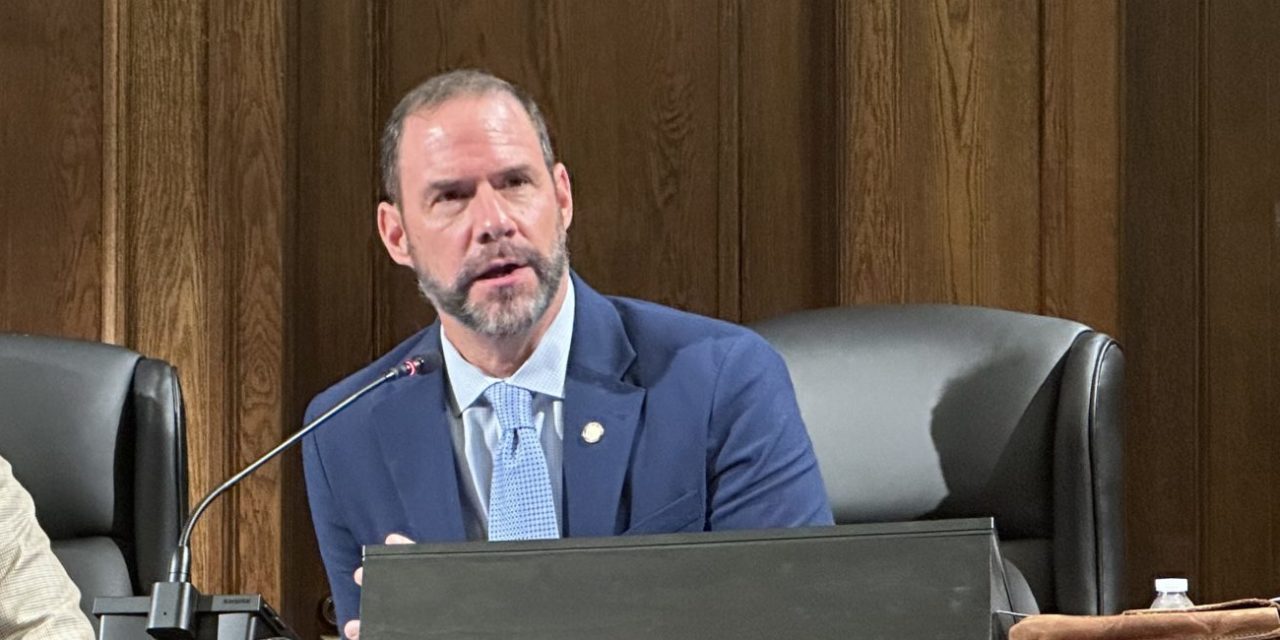
Commissioner Pat Tillman told the Rhino Times he believes Guilford County commissioners should seriously consider adopting a revenue neutral tax rate in the wake of the sharply higher 2026 property revaluation – and he also said he thinks he may already have four votes lined up to try.
Tillman, a Republican member of the nine-member board, said he’s been flooded with calls, emails and texts from concerned residents since the new property values were released.
“I’ve had more phone calls and emails and texts than I have – I mean it’s comparable to when I was on the Board of Ed during COVID and we were trying to get kids back in schools,” Tillman said in a recent interview. “Just the sheer volume of people that are concerned from every part of the county – north, south, east and west – it’s touching every community.”
County officials have estimated that if commissioners leave the tax rate unchanged under the new values, Guilford County would collect roughly $175 million more in revenue annually.
Skip Alston, the chairman of the Guilford County Board of Commissioners, told the Rhino Times last week that the board wouldn’t keep the full $175 million but he also said the county will likely need to retain a good deal of additional revenue to cover rising costs and growth.
Tillman is aiming higher. Or rather lower.
“All the policy levers should be on the table,” he said. “We shouldn’t rule out anything.”
He said the calls he’s receiving reflect “shock and fear” across the income spectrum.
“You take those on fixed incomes, for instance,” Tillman said. “I’ve had a number of people that have expressed the shock and fear of what can happen if the board doesn’t exercise some of those policy-making decisions on revenue neutral potentially, or something that holds these taxpayers harmless.”
“You take young people that have their first house or their first condo … They’re just able to pay the bills, have a little left over and maybe raise a family … They’re feeling the fear and anxiety and worry – what’s going to happen?”
“And then you take everybody in the middle – same thing,” he added.
Under state law, counties are required to announce a revenue neutral rate after a revaluation – the rate that would generate the same total property tax revenue as the previous year, excluding new construction.
If commissioners adopt that rate, the county doesn’t receive a windfall from higher assessed values alone.
However, even a revenue neutral rate doesn’t mean every homeowner’s tax bill would stay the same. Properties that rose more than the countywide average would still see higher bills – while those that rose less could see decreases.
The 2026 revaluation has produced dramatic increases in many neighborhoods, with some lower-valued homes jumping far more than the 40 to 45 percent average county officials had previously projected.
In some cases, properties have more than doubled compared to 2022 values.
Tillman said this revaluation appears to be generating even more concern than the last one four years ago.
“We have not faced such a monumental decision as this,” he said. “To me this is a really pivotal time in Guilford County history because we’ve just got to be even more judicious about it.”
He also said the anxiety extends beyond homeowners.
“This doesn’t just affect people that own their own home – it’s people that have an apartment,” Tillman said. “These landlords, they’re probably going to use this as a way to maybe even raise rates higher. Who knows?”
Tillman also pushed back on misinformation circulating online, including claims that the county commissioners somehow receive special treatment on their own property assessments.
He said such allegations are completely untrue and said he saw a hefty rise in his own property value.
While acknowledging that inflation and costs have risen in recent years, Tillman argued that commissioners must balance those realities against affordability concerns.
“In four years, most people would agree inflation and the cost of living has gone up,” he said. “But in this climate – with all the dynamics that are out there, the economy, affordability, fixed incomes, young people – we just have to make a wise decision here. And that’s going to require us to do hard things.”
Tillman said he currently believes he has four votes – including his own – that are inclined toward a revenue neutral or near-neutral approach. He said those commissioners are strongly concerned about minimizing the tax impact.
“I’m swinging for the fence,” Tillman said. “To get the best outcome for the citizens.”
He added that he believes a fifth vote is possible. That number of votes controls a nine-member board. If Alston does think county residents need much higher tax bills and the other Democrats vote against him and Carlvena Foster – the vice chair who also seems to think the county needs a lot of additional revenue – then it would be the first time in five years that the Democrats broke with Alston on a major issue – or, really, even a minor one.
But the timing may be right for a number of reasons. Commissioners Mary Beth Murphy and Carly Cooke have been on the board for several years now and that’s the time in office that commissioners over the years have traditionally stopped following the leader and adopting their own style. Also, Commissioners Kay Cashion and Frankie Jones Jr. aren’t running for their seats again and it’s unlikely they want their last act and legacy to be another giant tax hike on the county’s citizens.
Plus, the commissioners are all really hearing it from constituents this time around and one irate man who spoke from the floor at the board’s meeting last week wouldn’t leave the podium and it looked for a moment like security might have to remove him. Another speaker said he was starting a petition to get enough names to sue the county into keeping the tax rate revenue neutral.
At that same meeting, nearly every commissioner pointed out that they did not want to overburden county taxpayers and they reminded everyone that the tax rate has not been set. All that has happened so far is that property values have been reassessed higher.
“I think we could get there,” Tillman said of a revenue neutral rate, emphasizing that budget work sessions and public input will shape the final outcome before the board adopts a tax rate in June.
Meanwhile, Chairman Alston has argued that Guilford County is growing and must plan ahead for additional services, including EMS, sheriff’s deputies and infrastructure. The county has also discussed long-term facility needs and potential future debt, though no final decisions have been made.
Tillman said identifying needs is one thing – acting on them immediately is another.
“Just because we’ve identified issues, we have to ensure the timing is right,” he said. “Sometimes you have to tell people no. That’s hard to do.”
As the budget process unfolds, Tillman is encouraging residents to make their voices heard.
“I’m delighted that people are reaching out and calling their commissioners; that’s what it’s all about,” he said. “Share your concerns not just with me but come to our meetings and share your thoughts with the full board.”
All of the commissioners are encouraging taxpayers to come out to a series of upcoming budget town halls this spring.
Whether commissioners ultimately adopt a revenue neutral rate or settle somewhere in between, Tillman made clear he believes this year’s decision will define the board.
He pointed to a quote he liked from a past politician.
“With any kind of budget or funding of services, you can have anything you want – but you can’t have everything,” he said. “The question is: What is the anything?”




what a brave patriot. tillman is taking on skippy when the other commissioners sit idly by. unlike skip and the cabal of liberals tillman fights for what he believes in. we need more people like him. come november we gotta vote all the rest of thems outta here before the woke mob takes over what remains of our beautiful city
what a brave man that tillman is. standing up to skippy and his cronies when the others are too scared