
What began as one of the closest elections in North Carolina political history has now shifted slightly – though the outcome still isn’t officially final.
In addition to being one of the closest races in history, it’s also one of the most important.
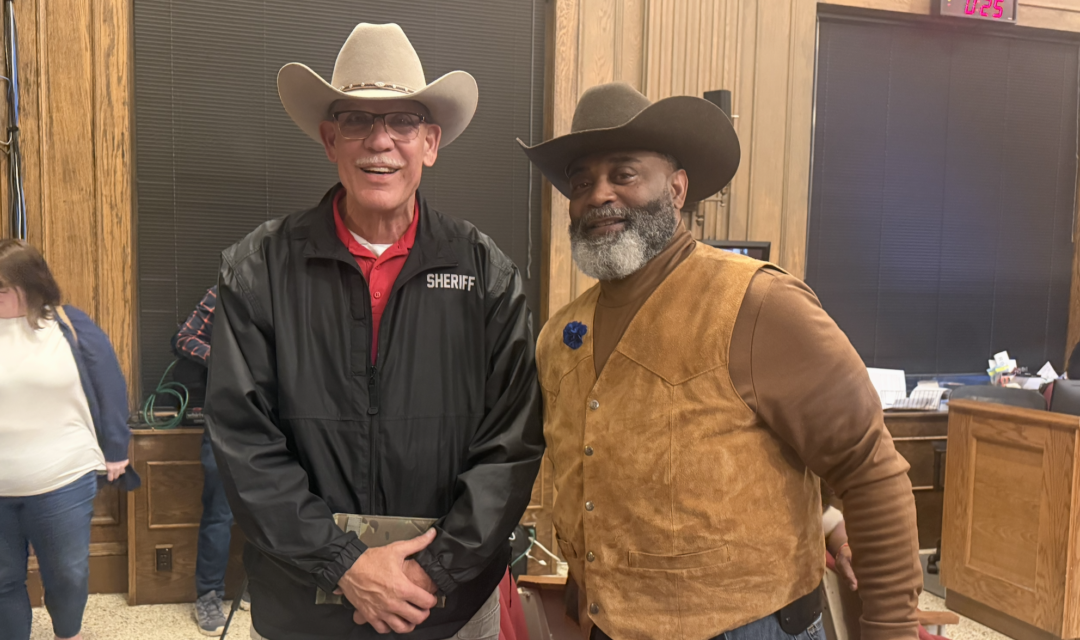
After provisional ballots were reviewed and counted on Friday, March 6, Rockingham County Sheriff Sam Page (pictured above with Guilford County Sheriff Danny Rogers at the Old Guilford County Court House, where they apparently arrived on horses) has expanded his narrow lead over longtime North Carolina Senate leader Phil Berger in the Republican primary for North Carolina Senate District 26.
Updated unofficial results now show Page ahead by 23 votes.
On election night, Page led Berger by just two votes out of more than 26,000 ballots cast – a margin so razor thin that it immediately raised the likelihood of a recount.
The new totals came after county boards of elections in Rockingham and Guilford counties reviewed provisional ballots and absentee ballots that required additional documentation.
According to election officials, Page gained 56 additional votes in Rockingham County from provisional ballots while Berger gained 26 votes there. In Guilford County, Berger added 10 votes while Page added three.
Those changes widened Page’s lead but haven’t resolved the race yet.
Additional ballots could still arrive before the totals are finalized: Military and overseas ballots that were mailed by Election Day have until March 12 to arrive in time to be counted.
County boards of elections are scheduled to conduct the official canvass of the results on Friday, March 13, after which the totals will be finalized at the county level.
Under North Carolina law, a candidate in a multicounty race may request a recount when the margin between candidates is extremely small.
The relevant provision in state law appears in North Carolina General Statute 163-182.7, which states: “In a statewide ballot item, statewide election, or a multicounty ballot item or election, a candidate or other requester may demand a recount if the difference between the votes cast for the apparent winner and the votes cast for the requester is not more than one percent (1%) of the total votes cast for that office or ballot item.”
Because Senate District 26 includes Rockingham County and part of Guilford County, the race is considered a multicounty election under the statute.
With more than 26,000 votes cast, the one-percent threshold would be roughly 260 votes.
The current 23-vote margin is therefore well within the range where a recount is allowed.
In a statement released Friday, Berger acknowledged the updated totals and said his team is evaluating whether to pursue a recount.
“While today’s results were not what we had hoped, the vote difference continues to be less than 1%, the threshold for requesting a recount,” Berger said. “As we wait for the election results to be reviewed one week from today, our legal team will continue to evaluate the situation. If we believe a recount is merited, I will pursue that avenue as allowed by law.”
(Read: He will request a recount if he comes up on the losing end.)
Page, meanwhile, sounded confident after the latest vote totals were announced.
Page is obviously delighted with where things stand. In a public statement to his supporters, he said: “Our numbers continue to build I’m very satisfied with the numbers we saw today, and I think that we’re at a point now that my opponent can’t catch up… I think we’ve won this and we’re going to keep moving forward to continue serving our citizens in Rockingham County and in Guilford County; and I appreciate everybody – all our volunteers, all our supporters, everybody who came out, our citizens in Rockingham County and Guilford County that stood behind us.”
Page added, “I’m looking forward to working for you all you’re my bosses. I’ll never forget who I serve.”
Although recounts exist to ensure accuracy in very close races, they rarely change the outcome of elections.
Most recounts simply confirm the original totals or shift them by only a handful of votes.
One of the most famous modern examples where a recount did change the outcome occurred in the 2008 U.S. Senate race in Minnesota between Republican Sen. Norm Coleman and Democrat Al Franken.
On election night, Coleman led by about 215 votes. After a lengthy recount and legal review of disputed ballots, Franken was ultimately declared the winner by 312 votes, flipping the result of the race.
Cases like that are unusual, however.
In most elections, recounts result in only very small changes to vote totals.
For now, the Berger-Page race remains technically unresolved until the canvass is completed and any recount requests are filed.
The contest has drawn statewide attention because Berger is one of the most powerful political figures in North Carolina. Since 2011 he’s served as president pro tempore of the North Carolina Senate and has played a central role in shaping state policy on taxes, budgets, education and other major issues.
As president pro tempore, Berger effectively controls the agenda of the Senate, making him one of the most influential elected officials in state government.
Berger entered the race with significant advantages, including the endorsement of President Donald Trump and millions of dollars in campaign spending by Berger and allied groups.
Page, who has served as Rockingham County sheriff since 1998, ran as an outsider candidate and capitalized on frustration among some conservative voters with long-time political leadership in Raleigh.
One issue that loomed large in the campaign was Berger’s support for a proposal to legalize resort-style casinos in rural areas of North Carolina, including a potential casino in Rockingham County.
Page was a vocal opponent of the idea, and the issue became a major point of tension between the two men. Page and others thought a casino could bring more crime to the area.
The provisional ballot count suggests Page’s strong base of support in Rockingham County helped expand his margin in the race.
Still, until the canvass is complete – and any potential recount process is finished – one of the most surprising political upsets in North Carolina in recent years remains just short of officially being decided.
Though, with a race of this magnitude and politics what it is today, it’s probably a good guess that the battle will move to the courts.