
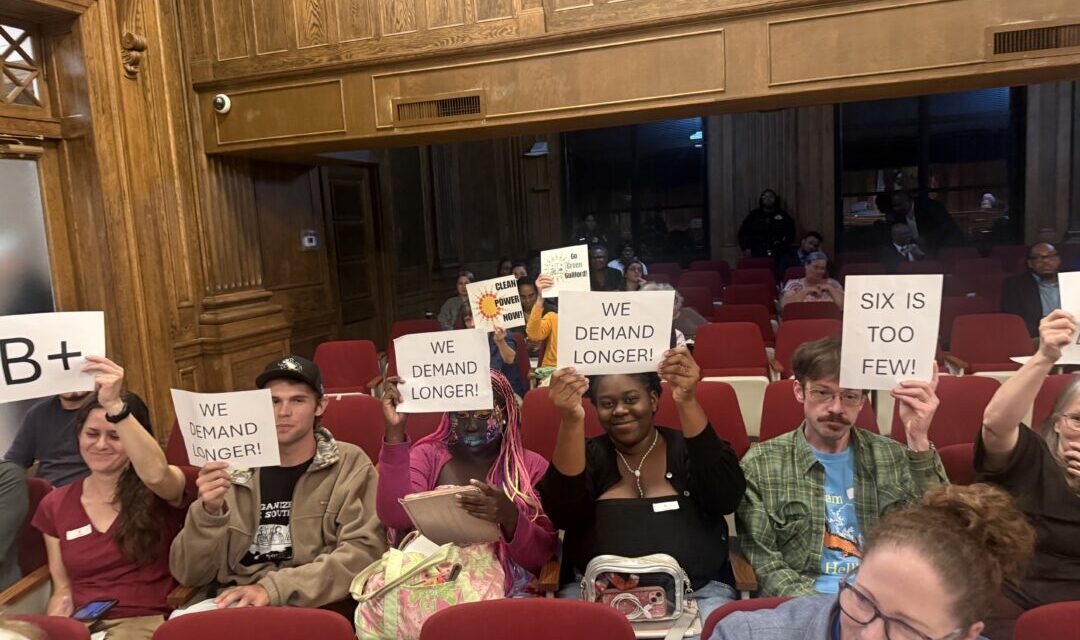
After punting on a proposed six-month moratorium on data centers last month, the Guilford County Board of Commissioners has come back with a much longer timeout.
On Thursday, Nov. 5, the commissioners unanimously adopted an 18-month moratorium following another public hearing on the increasingly controversial facilities. The county’s posted requested action sets the period from November 5, 2026, through May 5, 2028, and covers acceptance and processing of development applications for new data centers and associated data processing uses in unincorporated Guilford County.
Chairman Skip Alston told the Rhino Times that a second public hearing was necessary because the proposed duration had changed and the county attorney advised him a new hearing was therefore necessary.
Some of the same speakers who addressed the commissioners at the earlier hearing returned Thursday night and raised many of the same objections.
At the October 15 hearing, several speakers argued that six months wasn’t nearly enough time to study the issue and write meaningful regulations. Some wanted a 32-month moratorium.
Their concerns included heavy electricity consumption, water demand, noise, diesel generators, air pollution and the eventual expense of decommissioning facilities. Speakers also pressed for a formal citizens advisory committee.
Those objections help explain why data centers have become such a difficult sell: Residents are asking what these facilities would require from the community and what living near one would mean.
The county’s agenda materials identify utility capacity, infrastructure, environmental resources, public health and surrounding land uses as subjects for review. Staff’s planned work includes examining other jurisdictions’ approaches, developing zoning recommendations and gathering public input through town halls, a survey and potentially other methods.
At the October hearing, commissioners also heard a different concern – that waiting too long could send investment, jobs and tax revenue elsewhere.
Commissioner Alan Perdue, who moved to postpone the decision that night, questioned whether the original language could unintentionally affect telecommunications, emergency communications or government operations.
The November agenda materials spell out exceptions for server rooms and data processing equipment that are incidental to another permitted use and serve that use’s on-site operations. Examples include hospitals, financial institutions, offices and educational institutions, provided data processing isn’t the property’s principal use or primarily a service for off-site users.
The materials also provide for exemptions required by state law and say the moratorium could end before its outside expiration date if applicable zoning amendments are adopted.
After the decision, Aidan Loretz, a community organizer with the Haw River Assembly tole the Rhino Times that the group who wanted the long pause were pleased and this should give the board a chance to take it slowly and thoughtfully and make sure guardrails are in place so that the centers don’t disrupt the quality of life. Loretz also said there are some steps that can be taken to lower the negative impacts – for instance, he said, some data centers have closed loop water systems for cooling and those require less water usage than other systems because that water can be recirculated inside the center rather than constantly needing lots of water from public sources.