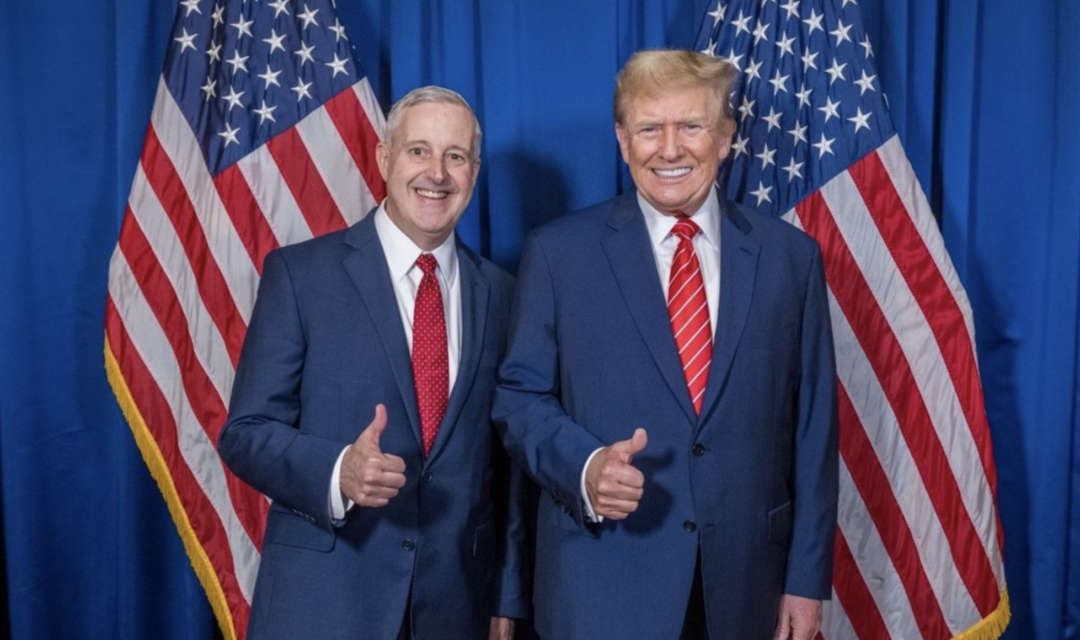
President Donald Trump is coming to North Carolina on Wednesday, Sept. 16, to try to give Republican US Senate candidate Michael Whatley a boost in a race where the polls indicate he could really use one.
Trump is scheduled to appear with Whatley at the Gastonia Municipal Airport, with the event scheduled to begin at 7 p.m.
Gastonia is home turf for Whatley – who lives in Gaston County and is running against former Democratic Gov. Roy Cooper for the US Senate seat being vacated by Republican Sen. Thom Tillis.
Whatley announced the Trump visit by writing, “President Trump needs an ally in the Senate and North Carolina needs a fighter.”
There’s little doubt why North Carolina is getting some presidential attention.
Cooper has led Whatley in virtually every recent public poll and has a big lead in the prediction markets as well.
A Sept. 10 Trafalgar Group poll had Cooper leading Whatley 48.2 percent to 42.3 percent. An East Carolina University poll conducted Aug. 31 through Sept. 3 found Cooper ahead 46 percent to 39 percent, with 14 percent undecided. When voters in the ECU poll were pushed to choose a candidate, Cooper led 52 percent to 44 percent.
An Elon University poll released this month had Cooper leading 49 percent to 38 percent, while an August High Point University poll had Cooper ahead 50 percent to 45 percent.
So far, Whatley hasn’t followed the strategy that some Republicans in competitive races have adopted: putting some daylight between themselves and Trump.
In fact, Whatley’s campaign website makes his relationship with Trump one of the central arguments for electing him.
The first issue listed under “Michael’s Plan for North Carolina” is “Enact the Trump Agenda in the U.S. Senate.”
That’s the first.
Whatley states, “I am committed to advancing President Trump’s America First agenda as the next U.S. Senator from North Carolina.”
The homepage also prominently identifies Whatley as “Endorsed by President Trump” and notes that Whatley led the energy, environment and agriculture teams during Trump’s 2016 presidential transition and later served as Republican National Committee chairman “at President Trump’s request.”
On immigration, Whatley’s website says he is “100% supportive of President Trump securing the border and deporting the millions of criminal illegal aliens that Joe Biden and Roy Cooper allowed into this country.”
On crime, Whatley says that as senator he would “stand shoulder to shoulder with President Trump to restore law and order.”
His campaign also emphasizes what it calls an “America First Economy,” opposition to illegal immigration, support for the Second Amendment, opposition to what the campaign calls “radical woke ideology” in schools, and hurricane recovery efforts Whatley says he pursued with the Trump administration.
There has been at least some effort by Whatley to make the campaign about more than Trump.
WFDD reported in July that Whatley was talking about Trump less frequently on the campaign trail than he had previously. Asked directly whether he needed to distance himself from Trump to win, Whatley didn’t say that he did. Instead, he said the way to win was to “draw a contrast with Roy Cooper.”
But that subtle change in campaign appearances hasn’t translated into removing Trump from Whatley’s campaign message. His website continues to put Trump and Trump’s agenda front and center.
That’s different from the approach being taken by some Republicans running in close races elsewhere across the country.
The Los Angeles Times reported last week that Republican US Rep. Young Kim of California removed references to Trump from her campaign website as she fights to retain her seat. The newspaper also reported that Republican Rep. David Valadao of California has been distancing himself from Trump and that Republican congressional candidates Carlos De La Cruz and Eric Flores in Texas deemphasized their Trump connections after winning their primaries.
Republican Sen. Susan Collins of Maine has taken an even more established approach: Collins has repeatedly broken with Trump on legislation and other issues and has made her independence from the president part of her political identity in a state where she faces another difficult reelection campaign.
Trump has criticized Collins publicly, and the Associated Press reported in June that the White House appeared prepared to give her more political space rather than insist that she campaign alongside the president.
Whatley has chosen a very different path.
Of course, having Trump campaign for a Republican in North Carolina is hardly an unreasonable strategy. Trump carried North Carolina in all three of his presidential campaigns, and Whatley will need strong turnout from voters who supported Trump if he’s going to erase Cooper’s current polling advantage.
But a Trump endorsement is no guarantee of success, even in a Republican primary race in North Carolina.
That was demonstrated dramatically earlier this year when Trump strongly endorsed longtime NC Senate President Pro Tem Phil Berger in his Republican primary against Rockingham County Sheriff Sam Page.
Berger had been one of the most powerful Republicans in North Carolina for more than a decade, had Trump’s endorsement and massively outspent Page.
It still wasn’t enough.
After recounts and legal challenges, Berger conceded the race to Page in March. Page won by just 23 votes out of more than 26,000 cast despite Berger reportedly outspending him by more than 40-to-1.
There’s an obvious difference between that race and the Cooper-Whatley contest.
Page was challenging Berger in a Republican primary where both candidates were competing for conservative voters. Whatley is running in a statewide general election where attracting Republicans is only part of the job. He also needs enough unaffiliated and swing voters to defeat Cooper. But Trump can motivate voters on the other side as well, particularly at a time when his approval ratings have fallen and Republicans are facing a difficult national political and economic environment. The question for Whatley is whether Trump can help him turn out enough Republican voters to overcome Cooper’s advantage elsewhere.
This is one of a handful of contested Senate races that could decide if Trump will be allowed to continue to operate as president in the ways he has been or if he will largely be a lame duck for two years when it comes to things that can’t be done with an Executive Order.
On Monday, Sept. 14, the Kalshi prediction market flipped from favoring Republican control of the Senate after the election to favoring the Democrats.