
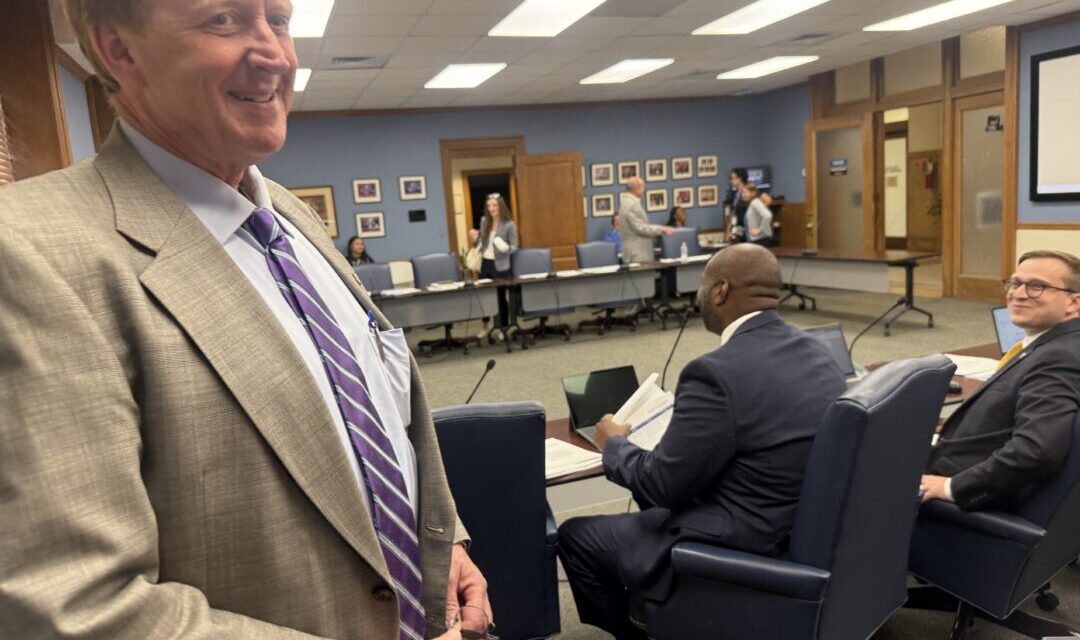
It’s very rare that a county employee gets a rousing round of applause when he or she walks into a conference room for a Guilford County Board of Commissioners work session, but that’s exactly what happened to longtime Emergency Services Director Jim Albright – since he was recently promoted.
He was also looking spiffier than usual with is upgraded attire, a suit and tie, as he walked into the Thursday, Sept. 3 afternoon work session.
When Guilford County government has formed a committee, task force, working group or special initiative involving public safety, mental health, opioid addiction or some complicated problem that crosses departmental lines over the last couple of decades, there’s a pretty good chance Jim Albright has been involved in it.
Now Albright, who’s spent more than three decades with Guilford County Emergency Services and more than 12 years running the department, will have considerably more of county government to worry about.
Guilford County Manager Victor Isler has just named Albright the county’s new assistant county manager. In that position, Albright will oversee Animal Services, Emergency Services, Juvenile Detention, Parks and Recreation, Planning and Development, Inspections and Security.
He’ll also serve as the county’s liaison to the rural fire districts.
Albright’s first official day in the new job will be Monday, Sept. 7.
The promotion makes sense in one respect because, despite Albright’s longtime title of Emergency Services director, his work for the county has extended well beyond ambulances, paramedics and emergency response.
For years, Albright has been involved in the county’s attempts to solve problems that don’t fit neatly inside the organizational boxes on a county government flow chart.
One good example is the problem of people who call 911 over and over again, sometimes for situations that don’t really require emergency medical treatment.
In one memorable case, a man in a wheelchair who lived in a second-floor apartment with no elevator would call 911 every time he needed help getting into his residence.
An ambulance could come, paramedics could get him upstairs and the immediate problem was solved – but nothing had really been solved at all because the same problem would arise the next time he needed to get into his apartment.
The county eventually took a different approach, bringing departments together and helping find the man housing that he could get into without calling 911.
That type of effort evolved into programs like the Guilford County Adult Resource Team – a collaboration between Emergency Medical Services and Adult Protective Services that works with some of the county’s most frequent 911 callers.
Rather than simply sending an ambulance every time the phone rings, the idea is to determine why the person keeps calling and, when possible, fix the underlying problem.
The Adult Resource Team assisted more than 160 county residents in 2024 and greatly reduced the number of 911 callers from those constant repeat callers.
Albright was also heavily involved for years in the county’s attempts to improve its troubled mental health system. Back in 2017, when county commissioners were looking for ways to regain more control of mental health services from the multi-county Sandhills Center, Albright was one of the officials explaining how badly gaps in that system affected Emergency Services.
People would receive treatment or medication and then leave without knowing where to go next. Particularly in bad weather, Albright said at the time, they would end up calling 911, riding in an ambulance and landing at Wesley Long Hospital.
Albright even tried Sandhills’ online assessment system himself one night, pretending for purposes of the test that he was using heroin.
After telling county commissioners about his experiment, he added: “So if you get any reports, I swear I will drug test today.”
That wasn’t Albright’s only involvement with the opioid crisis.
He became a founding member of Guilford County Solution to the Opioid Problem – better known as GCSTOP – which brought people from multiple agencies together to follow up with overdose victims and attempt to get them into treatment rather than simply revive them, leave and wait for the next overdose call.
In 2018, Albright reported that opioid-related deaths in Guilford County had fallen dramatically even though the number of overdose calls had increased. He cited wider use of Naloxone and programs such as GCSTOP as factors helping keep people alive.
He also played a major role in the development of the Guilford County Behavioral Health Center and was deeply involved in the county’s response to COVID-19.
During the worst of the pandemic, when ambulance demand became enormous and response times were suffering, Albright went before the commissioners pleading for extraordinary measures to bring in outside ambulance help.
His PowerPoint presentation opened with the words: “Desperate times call for desperate measures.”
Albright has also spent a good portion of his career dealing with the less dramatic, but frequently aggravating, nuts and bolts of county government.
For years, Emergency Services badly needed a new maintenance and storage facility for its growing fleet.
At the old facility, workers sometimes had to service vehicles outside, and much of the county’s expensive emergency equipment was stored outdoors.
When discussing the type of storm-resistant building the county needed, Albright noted that a properly designed emergency facility might qualify as a “Category 4” structure.
As for the county’s existing outdoor vehicle storage, Albright had another classification for that.
“I consider that Category 0,” he said.
At another point in the years-long effort to get the new facility built, Albright described Emergency Services as “absolutely jammed into a shoebox.”
Albright joined Guilford County in 1989 and worked his way through an unusually long list of Emergency Services jobs – paramedic, EMS captain, EMS assistant shift commander, training officer, administrative officer, deputy director and finally director.
He spent 15 years as deputy director before taking the top job.
He’s a Greensboro native and Grimsley High School graduate with an educational background that isn’t exactly what most people would guess after looking at the flashing lights and ambulances that have surrounded most of his career.
Albright has a bachelor’s degree in economics from UNC-Chapel Hill and a master’s degree in accounting from UNC-Greensboro.
He’s been a North Carolina credentialed paramedic since 1988 and a nationally registered paramedic since 1996.
Isler said Albright’s long tenure and broad experience made him a good choice for the new position.
“Jim has spent his career serving the people of Guilford County, and he brings a combination of operational experience, trusted leadership, and a deep understanding of our organization and community,” Isler said in announcing the appointment.
Albright said he was grateful for the chance to continue working for the county in a new role.
“I have been fortunate throughout my career to work alongside talented and dedicated public servants who care deeply about this community,” he said. “I look forward to building on those relationships, supporting our departments, and helping the county continue to deliver high-quality services to our residents.”