
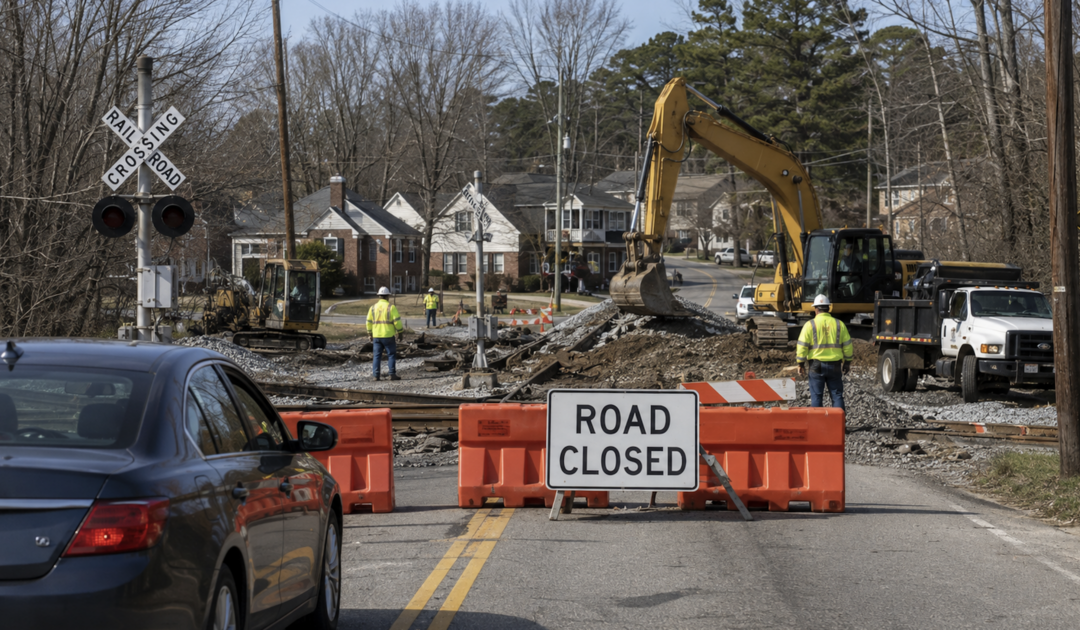
There’s no progress without some aggravation, and there will certainly be plenty of that for Guilford County drivers due to a major effort to upgrade the rail system throughout the county.
A major railroad improvement project coming through Guilford County later this month is going to create headaches that come with road closures and detours. For residents of two areas in the county, however, the problem will be considerably more serious.
For as much as 12 hours on the day the work is done, people living off Wagoner Bend Road and Buchanan Church Road could find themselves with no normal way to drive into or out of their neighborhoods while railroad crews tear out and replace the tracks at the crossings.
That means residents who leave in the morning may not be able to get back home until late that evening, while residents who stay home could find themselves unable to leave by car until the work is completed.
Guilford County staff laid out the unusual problem for the Guilford County Board of Commissioners at a work session on Thursday afternoon, Sept. 3, held in the Carolyn Coleman Conference Room in the Old Guilford County Court House.
Guilford County Economic Development Manager Heather Schaffer kicked off the presentation by explaining that the county isn’t running the project and doesn’t control either the construction schedule or the road closures. However, county officials learned several weeks ago just how disruptive the work could be and they have been scrambling to prepare residents, schools and emergency responders for it.
The work is part of the Carolinian Piedmont Passenger and Freight Improvements project, generally known by the less-than-catchy acronym CAPPFI. The North Carolina Railroad Company – working with Norfolk Southern – is replacing nearly 70 miles of aging rail between Greensboro and Raleigh as part of a larger modernization of the state’s rail infrastructure.
Work started in Mebane on August 24 and is now moving west toward Guilford County. The current estimate is that work will reach Guilford County sometime around the middle of September and be completed in the county by early October – although that schedule remains highly dependent on weather, equipment and crew availability.
That uncertainty is one reason why county officials can’t yet tell residents exactly what day their crossing will close.
Most of the affected railroad crossings won’t create anything more dramatic than a detour.
There are 23 crossings on the county’s current list, including Elm Street, Dudley Street, Gillespie Street, English Street, Holts Chapel Road, Pine Street, Lowdermilk Street, Franklin Boulevard, Oferrell Street, Ward Road, Maxfield Road, Buchanan Church Road, Wagoner Bend Road and a number of crossings farther east toward Gibsonville.
But Wagoner Bend Road and Buchanan Church Road are different: In those areas, the railroad crossing provides the only vehicular access into the neighborhood.
Once the rails and crossing surface are removed, there simply isn’t another street that residents can take around the work.
A county map shown to commissioners highlighted those two areas and described them as neighborhoods with “only one access point.” A private road is also listed by the county as a sole-access location, while Gibsonville will face a different problem because several nearby crossings could be closed in succession. Gibsonville at least has the Whitsett Avenue rail overpass, which will preserve access to downtown.
The county estimates that 66 residences on 127 parcels are in the main focus area around the two most troublesome crossings. About 1,000 people live within a mile of that area and 18 Guilford County Schools students, ranging from pre-K through 11th grade, could be affected.
The working plan is for normal access across those crossings to be unavailable from approximately 7 a.m. until 7 p.m. on the day the work is performed.
Originally, county officials had heard estimates that a crossing could be closed for two to four days. During Thursday’s discussion, however, railroad representatives said the goal for these particularly difficult crossings is to get the entire job done in one day.
That still makes for one highly inconvenient day.
Commissioner Kay Cashion asked what happens to someone who has a medical appointment or another important reason to get out during that period.
A railroad representative on speakerphone acknowledged that there isn’t a perfect answer: Residents will have to plan their daily activities around the closure and, where possible, make arrangements before the crossing is taken apart.
“There is some impact,” he told commissioners, noting that there’s no way to reduce the inconvenience to zero when a neighborhood has only one way in and out across the railroad.
Commissioner Alan Perdue, who used to be the county’s Emergency Services director, said he’s been through a few of these over the years. He suggested identifying a location on the other side of the crossing where residents might be able to leave a vehicle ahead of time, walk across the tracks safely and use that vehicle for appointments or other necessary trips.
Schaffer said the county is looking at possibilities along those lines.
Emergency access is another matter.
County officials said special arrangements are being made so police, fire and EMS crews can get into the affected neighborhoods even while the crossings are torn apart.
The county’s 911 system will be given mapping information showing the closures. If an emergency call comes from one of the isolated areas, crews at the crossing can be alerted and gravel or rock can be put down to provide temporary emergency access.
That’s not intended to become a temporary public road residents can use all day, but it should keep the railroad work from leaving a neighborhood unreachable by emergency responders.
The county is also sharing information with Guilford County Schools so the school system can adjust bus stops and transportation plans for the 18 students who may be affected.
Commissioner Carly Cooke raised what would seem to be the obvious solution: Why not just do the work at night?
Railroad officials said that isn’t really an option.
The work involves long groups of heavy mechanized equipment and railroad construction operations that officials said can’t safely and properly be performed in darkness. Railroad representatives also cited labor agreements governing Norfolk Southern’s construction crews.
There’s another wrinkle.
The railroad itself can’t operate normally while the rails are being replaced.
Railroad representatives said that passenger trains will continue running during much of the project, but some midday service will be replaced by buses. The goal is to get the track back together each evening so evening passenger trains and freight traffic can resume.
That gives the railroad plenty of incentive to finish each day’s work quickly. When the crossing is torn apart and the rails are being replaced, motorists aren’t the only ones who can’t get through. Neither can the trains.
Commissioner Pat Tillman pushed officials to give residents more practical information about detours, including estimates of how much extra time they may add to a trip.
He said knowing that a detour is going to add, for example, 15 minutes, would make it much easier for people to adjust their schedules rather than simply being told that a road is closed.
County officials agreed to look at adding that type of information to the project’s website.
They don’t have much time to get on top of all this.
Schaffer said county officials only learned of the project and began coordinating their response about three weeks ago. Since then, the county has been working with Guilford County Schools, Emergency Services, Social Services, Animal Services, the Sheriff’s Office, Greensboro police and fire departments, McLeansville Fire Department and the Town of Gibsonville.
The county plans to update an online interactive map daily as the work gets closer, showing road closures, reopenings and detours. That information will also be fed into mapping systems used by Google Maps and Waze.
Residents in the most heavily affected communities are supposed to receive bilingual postcards, and officials are planning yard signs near crossings, flyers at area businesses, social media announcements and other notices. Railroad officials said Thursday that bilingual door hangers were also being prepared.
Commissioner Carlvena Foster asked about weather, which could make the timing even harder to predict.
Schaffer said weather can affect the schedule, which is why officials don’t want to announce a specific closure date too early and then have it change.
Railroad representatives said they’re trying to strike a balance: Give residents as much advance notice as possible – but don’t give them a date until the work is close enough that there’s a good chance the railroad can actually keep it.
As of Thursday afternoon, the best estimate was still that the work would reach Guilford County around mid-September.