
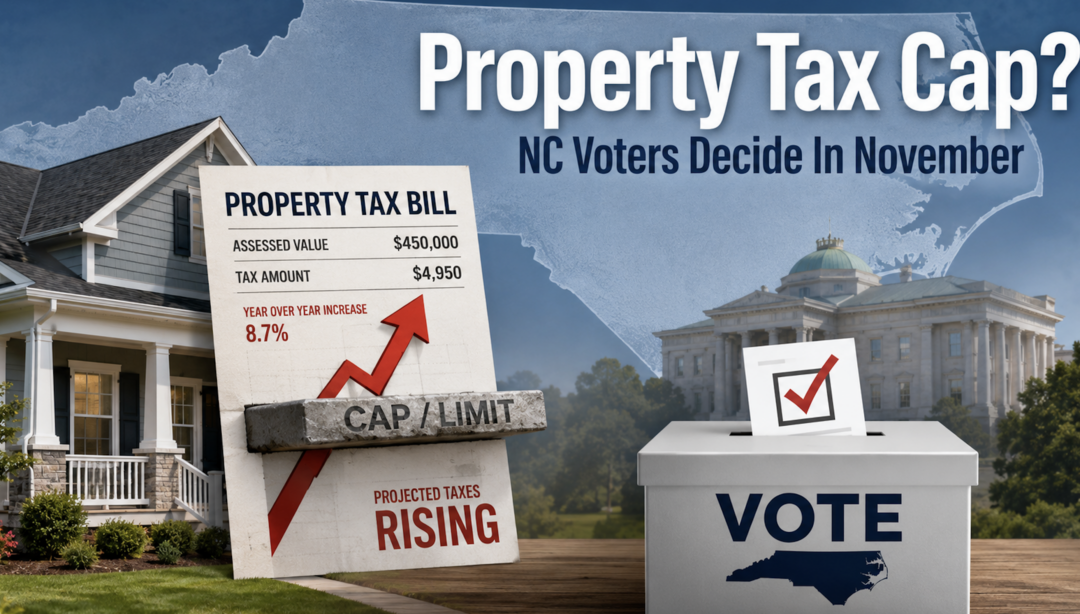
North Carolina voters will get a chance to decide in November whether the state constitution should require limits on property tax increases by local governments.
The NC House and Senate have both approved House Bill 1089 – a proposed constitutional amendment titled “Constitutional Amendment Property Tax Levy Limit.”
The bill has already become Session Law 2026-5, which means the question is headed to the statewide ballot in November.
However, voters won’t be voting on a specific property tax cap.
They’ll be voting on whether the state constitution should be amended to require the North Carolina General Assembly to enact laws limiting the amount by which local governments can increase property tax levies.
The ballot question will ask voters whether they support a “Constitutional amendment requiring limits on property tax increases by local governments.”
The proposed amendment doesn’t set a specific limit. It doesn’t say that property taxes can only go up by 3 percent, 3.5 percent, the inflation rate or any other number.
It also doesn’t spell out what exceptions would be allowed for debt, schools, emergencies, population growth or other local needs.
Instead, it would put language in the state constitution requiring the NC legislature to come back later and pass laws creating a property tax levy limit.
In other words, voters aren’t being asked to approve a specific property tax cap: They’re being asked to order the legislature to create one later.
A levy limit is different from a direct cap on the value of a home or a direct cap on an individual tax bill. Generally speaking, a property tax levy is the total amount of money a local government collects from property taxes. A limit on that levy would restrict how much the total property tax revenue collected by a county, city or other local taxing unit could grow from one year to the next.
That means the details will matter enormously. A future implementing law could determine whether the limit is tied to inflation, population growth, new construction, voter approval or some other formula. It could also determine whether certain expenses are exempt from the cap.
The amendment was pushed by Republican lawmakers who say homeowners across North Carolina are being hit too hard by rising property tax bills after counties conduct revaluations.
Property values have increased sharply in many parts of the state in recent years, and when those higher values are paired with tax rates that don’t fall enough to offset the increase, homeowners can see significantly higher tax bills.
That’s been a major issue in Guilford County this year, where the 2026 revaluation produced large increases in property values and County Manager Victor Isler recommended a budget that would lower the tax rate but still bring in far more property tax revenue.
Supporters of the amendment say the state needs to protect property owners from being priced out of the homes they already own.
Opponents argue the amendment could make it harder for counties and cities to pay for schools, law enforcement, emergency services and other local government functions.
They also claim that the amendment is too vague because it doesn’t tell voters what the actual cap would be.
Chairman of the Guilford County Board of Commissioners Skip Alston told the Rhino Times on Tuesday, June 9, that he wasn’t convinced voters will approve the amendment in November.
Alston said a large majority of the speakers at the county’s Thursday, June 4 public hearing on the budget urged commissioners to raise taxes if that’s what it takes to fund county services.
At that hearing, more than 40 people spoke on County Manager Victor Isler’s recommended 2026-2027 fiscal year budget – and Alston said that most of them spoke in favor of providing additional funding for schools, employee raises, the Sheriff’s Department, social services and other county needs.
Alston said he believed 34 of the 44 speakers essentially told commissioners to raise their taxes.
“I’m not sold on the fact that voters are going to vote for that,” Alston said of the proposed constitutional amendment.
Alston also said the public debate over the county budget shows that many residents want services funded, even if that means higher taxes.
“If they see what the situation is going to bring this year with our budget and after we tell them what it’s going to take in order to provide services to them this year, and they’re not going to be able to get the services, they may vote it down.”
The bill passed the House 73-46 and the Senate 31-15.
Since it’s a constitutional amendment, NC Governor Josh Stein doesn’t get to sign it or veto it. Constitutional amendments approved by the General Assembly go straight to the voters.
If a majority of voters approve the amendment in November, the new language would be added to the North Carolina Constitution. However, that still wouldn’t immediately create a detailed property tax cap. The General Assembly would still have to pass the actual law spelling out how the levy limit would work.
That also means the amendment won’t affect Guilford County’s current budget process.
The Guilford County Board of Commissioners is scheduled to adopt the 2026-2027 county budget on Thursday, June 19. The property tax amendment won’t be voted on until November and, even if it passes, the legislature would still have to write the implementing law before any detailed property tax cap could be put in place.
A separate bill moving through the legislature which is expected to pass, Senate Bill 889, could affect Guilford County much sooner because that bill deals with whether counties with 2026 revaluations can use those new values for the coming fiscal year.
But House Bill 1089 is the broader, statewide question that will go before voters this fall.