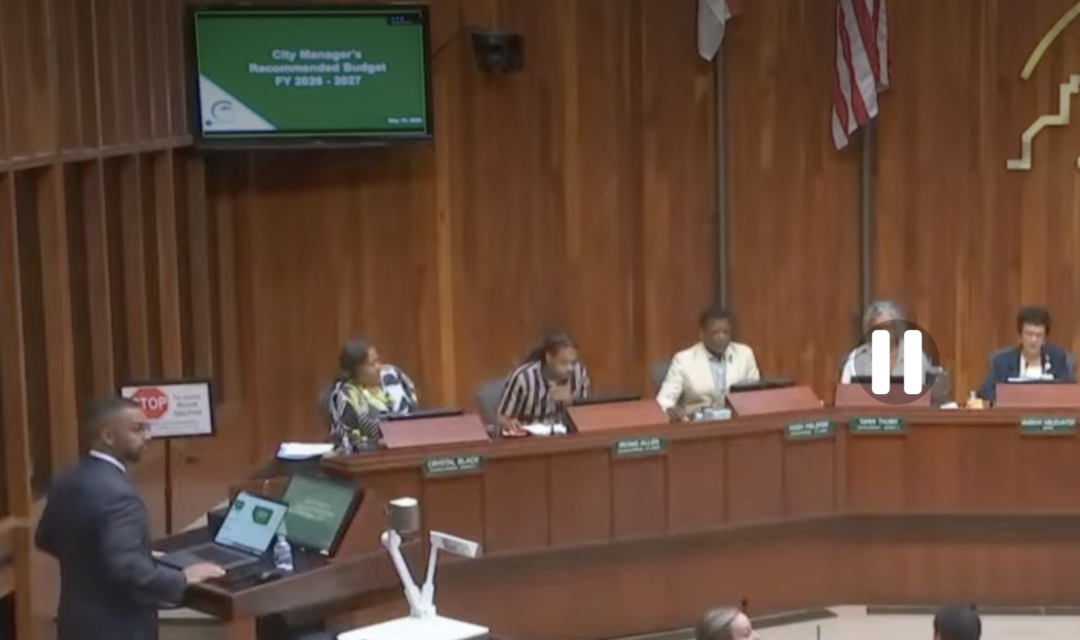
Greensboro City Manager Trey Davis presented his proposed $913 million budget for fiscal year 2026–2027 on Tuesday night, May 19 and the headline number city officials are emphasizing is an 8.95-cent property tax rate cut.
The current city tax rate is 67.25 cents per $100 of assessed valuation. The proposed rate is 58.30 cents. On paper, that sounds like a very nice tax cut; however, since 2026 is a countywide revaluation year in which property values sky rocketed, most Greensboro property owners will see higher city tax bills despite that touted lower rate.
Of course, this is just Davis’ recommended budget; the one that really matters is the one the Greensboro City Council adopts next month.
City finance officials state that a true “revenue neutral” tax rate would be about 48 cents. Instead, the proposed rate is 10.3 cents above revenue neutral – which means the city is taking in a sizable tax increase from the revaluation even while lowering the tax rate.
That won’t likely make many taxpayers happy – especially since Greensboro residents are also facing a similar threat from Guilford County government, where the county manager has proposed a lower tax rate that would still generate substantially more revenue because of sharply higher property values.
The city’s public messaging in a press release after Davis presented the budget repeatedly emphasizes that the rate is lower than last year’s rate. What it talks about a whole lot less is the fact that the city is still proposing a major increase in total spending and, therefore, tax collections. The recommended budget represents an increase of $82.7 million – a 9.9 percent spike over the current budget for fiscal year 2025-2026 – which wraps up on June 30.
Property tax collections alone are projected to jump 21 percent to $329 million in the coming fiscal year. That’s an enormous one-year increase in city property tax revenue.
And while city officials frame the budget as balancing “affordability” with maintaining services, the budget document unveiled Tuesday night makes it clear that Greensboro is facing rapidly escalating operating costs almost everywhere you look. The manager’s budget message repeatedly points to higher costs for public safety, technology, solid waste disposal, transit contracts, healthcare premiums, retirement contributions, software subscriptions, utilities, infrastructure maintenance and personnel.
In other words, Greensboro is increasingly becoming a place where simply maintaining the status quo costs dramatically more each and every year.
The proposed budget includes a General Fund budget of $485.9 million and a total budget across all city funds of $913.2 million.
The budget reveals a city government trying to manage several competing pressures all at once – rising labor costs, aging infrastructure, growing public safety demands, increasing housing pressures, expensive technology systems, major capital needs, and public demands for more services without massive tax increases.
One thing that stands out immediately is how dominant personnel costs have become for the city. Those costs account for 41 percent of the entire city budget. (That’s about the same percentage that Guilford County now contributes of its budget to education in the county each year.)
What’s more, the city’s percentage of labor costs understates the true labor impact on the budget since many of the contracted services are effectively labor costs that are outsourced through vendors.
The budget the manager presented to the City Council this week includes the following personnel perks: a 2.5 percent cost-of-living raise for general employees, an average 1.5 percent merit increase, 4 percent step increases for police and fire employees, an increase in the city minimum wage for benefited employees from $20 to $21.25 per hour, and a roster employee minimum wage increase from $17.21 to $18 an hour.
City leaders clearly believe workforce retention is becoming increasingly difficult and workers must be paid to stay. Private-sector wage pressure, inflation and competition for skilled workers have all combined to force cities and counties across the state to raise pay more aggressively than they have historically.
Greensboro appears to be trying to quietly reposition itself as a higher-paying municipal employer. A $21.25 minimum wage for full-time city employees is well above what many private employers in the area pay.
Public safety remains the dominant political priority in the manager’s budget. The proposal now on the table includes funding for 30 new police officer positions; however, the budget presentation notes that a federal COPS grant will offset part of those costs for three years.
That matters a lot because it means that some of the apparent expansion in policing is temporarily subsidized by federal money. For both the city and the county this is how government job growth takes place – there will be grant funds or federal or state funds paying for positions at the start and then, when the outside money runs out, the local government just starts picking up the tab rather than eliminate those positions.
Eventually, unless those positions disappear, Greensboro taxpayers will end up absorbing the full cost.
The budget also continues funding for the city’s Behavioral Health Response Team, violence interruption programs and neighborhood engagement efforts. Those programs reflect the city’s ongoing efforts to move toward a more layered public safety model that combines traditional policing with mental health and intervention approaches. Whether they are producing measurable results remains a matter of much debate.
One particularly interesting section of the budget involves technology spending. The city specifically cites rising costs associated with the Axon platform and Motorola radio systems.
Cities increasingly depend on expensive proprietary technology ecosystems, and Greensboro is no different. Police body cameras, digital evidence storage, emergency radio systems, software licensing, cybersecurity systems and cloud-based management platforms all create recurring costs that increase year after year. Once governments adopt those systems, switching away later often becomes extremely difficult and expensive.
Unlike roads or buildings, technology systems often become obsolete quickly – while also becoming more expensive to maintain. That creates a structural budget pressure that local governments didn’t face to nearly the same extent twenty years ago.
And, if the manager has his way, property tax hikes for residents won’t be the only new cost they’ll endure during a period when many residents are already struggling with rising costs. The proposed average water and sewer rate increase is 10.25 percent. That’s a big jump. While the property tax discussion will of course dominate public debate, utility increases often hit residents hard as well – especially lower-income households. And, in general it is the lowest priced houses that have increased in value the most during the reval.
Davis says the increase is needed to support maintenance projects and infrastructure investment. The city’s Water Resources budget alone totals $212.8 million.
The proposed budget also includes $37.2 million in PAYGO transfers for maintenance projects. PAYGO means “pay as you go” – that is, essentially, using current revenues rather than borrowing money. From a fiscal standpoint, that’s generally more conservative than financing everything through debt – a favorite practice of Guilford County government.
Still, all this reflects the enormous cost of maintaining water and sewer infrastructure – something that much of the public never notices until something breaks.
The budget proposal also strongly hints that Greensboro leaders are preparing for another large bond referendum. The city says the budget supports planning for a proposed 2026 referendum to address capital needs.
Another part of the budget involves staffing. The city says it’s making “strategic resource reductions” of 5.5 full-time equivalent positions while simultaneously adding 48 priority service enhancement positions. So, the reductions in the budget are minor compared to the additions.
Some of the new positions involve water resources maintenance crews, stormwater crews, heavy equipment operators and staffing for the new Windsor-Chavis-Nocho Community Complex.
Large public facilities – like that brand new Community Complex – often generate major ongoing operational costs after construction is complete due to staffing, maintenance, utilities and programming. City taxpayers sometimes focus heavily on construction costs – but then they underestimate the long-term operating obligations that follow.
Housing, of course, continues to occupy a central place in city policy. This budget continues funding for the “Road to 10,000 Housing Initiative,” housing preservation, down payment assistance and multifamily housing production.
The Nussbaum Housing Fund budget is proposed to be $6.8 million.
Housing policy has increasingly become one of the defining priorities of Greensboro government as well as Guilford County government over the last several years.
One key tension underlying the budget is this: Even as the city invests heavily in affordable housing initiatives, rising taxes, rising utility costs and rising development costs all make affordability harder to achieve.
Some city revenue assumptions rely on development continuing at a healthy pace. If growth slows sharply due to interest rates increases or economic stagnation, that could eventually create some real stress on the proposed budget given the growth assumptions in it.
The city is planning an additional $1.8 million in economic development incentives in fiscal 2026-2027. Supporters argue incentives remain necessary to compete with other cities for jobs and investment. However, critics see this as corporate welfare and argue that governments often overpay for development that would have happened anyway.
The city makes it clear that Greensboro officials understand the city is entering an era where simply maintaining current service levels is becoming increasingly difficult and expensive. The city specifically cites more than $8 million in “cost of maintaining services” increases alone.
And that’s before adding any new initiatives – of which there are plenty.
Another thing likely to concern Greensboro taxpayers is the pace of overall budget growth compared to population growth.
This proposed budget increase would be nearly 10 percent in one year. Greensboro’s population certainly isn’t growing anywhere near that rate annually. So, citizens are likely to ask whether city government itself is becoming structurally more expensive faster than residents’ incomes are growing.
City leaders also place heavy emphasis on “competitiveness” in this budget. They increasingly seem focused on positioning the city competitively against peer cities – such as Charlotte and Raleigh – for investment, workforce talent, housing growth and economic development.
The City Council budget work sessions are scheduled for May 21, May 28, June 4 and June 11. The public hearing on the manager’s proposed budget is June 2 – with final adoption by the Greensboro City Council planned for