

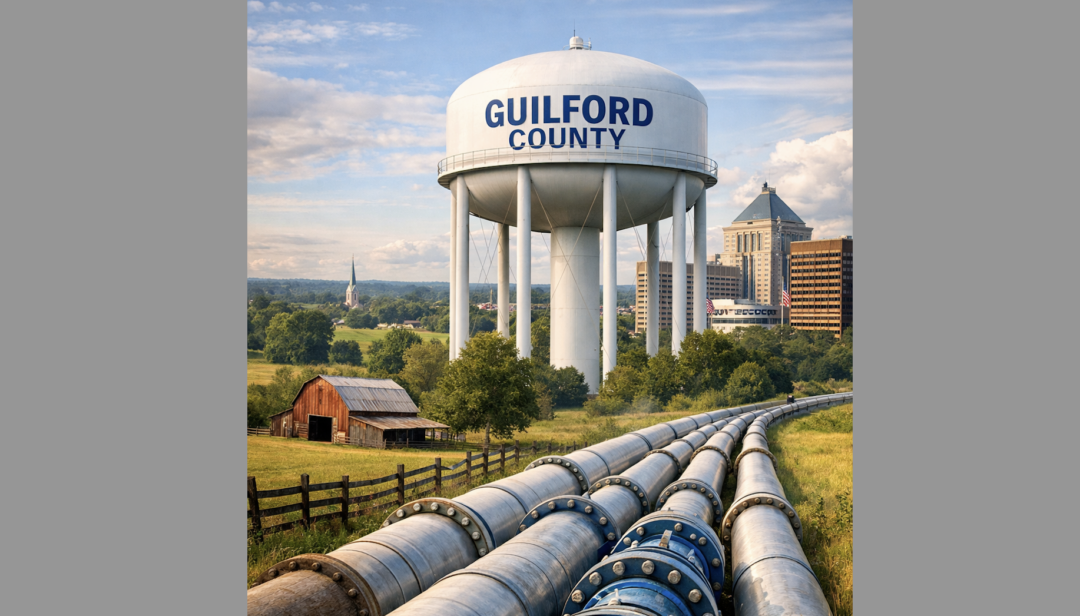
The Guilford County Board of Commissioners is expected to lend its formal support this week to a regional water planning effort that local leaders say will be critical to managing the Piedmont Triad’s rapid growth in the coming decades.
At their Thursday, March 19 meeting, the commissioners are scheduled to adopt a resolution backing a newly completed Master Planning Study by the Piedmont Triad Regional Water Authority (PTRWA).
The item appears on the board’s consent agenda for the meeting – a list of routine measures that are typically approved together without discussion.
The resolution expresses the county’s support for the authority’s long-term planning work and for its recommendation that the region move forward with developing additional wastewater capacity through a coordinated regional approach.
According to the resolution, the Piedmont Triad Regional Water Authority “has a longstanding commitment to providing reliable, high-quality water services to its member communities” and has played an important role in supporting “economic growth and environmental stewardship across the Piedmont Triad region.”
The measure further notes that the authority has been studying how the region can expand water and wastewater capacity to meet future demand.
“In 2023, PTRWA assembled an exploratory committee to look at regional water and wastewater capacity development,” the resolution states.
It goes on to explain that, in 2024, the authority completed a strategic plan aimed at establishing the organization as a regional utility capable of coordinating both water and wastewater services across Guilford and Randolph counties.
The resolution to be adopted also states that the authority has developed a business case for expanding its regional capacity portfolio and that further feasibility work will be required before specific projects move forward.
The Board of Commissioners’ action doesn’t commit Guilford County to any particular construction project or funding plan right now. Instead, the resolution is primarily a statement of support for the authority’s planning work and its role in evaluating potential regional solutions.
The measure concludes that the county board “affirms the county’s ongoing commitment to PTRWA’s leadership role and capability to prioritize and fully evaluate recommended regional utility capacity development alternatives.”
The item is sponsored by Commissioner Kay Cashion.
While the resolution itself is brief, the broader issue of water and wastewater capacity has been the subject of intense discussion among local leaders for several years.
In November 2025, county commissioners held a lengthy work session on the topic in the Carolyn Coleman conference room in the Old Guilford County Court House.
At that meeting, Gregory Flory, the executive director of the Piedmont Triad Regional Water Authority, walked the board through a regional master planning effort that looked at water and sewer needs through the year 2050.
Flory’s message to commissioners at the time was straightforward: The scale of infrastructure required to support future growth will be too large for any single city or town to handle alone.
Instead, he told the county leaders, the region will have to work together.
The Piedmont Triad has already seen a surge of economic development in recent years, including major industrial projects such as the $14 billion Toyota battery plant just across the Guilford-Randolph County line.
At the same time, residential growth continues across the county, with new subdivisions and commercial development steadily increasing demand on existing utilities.
Consultants who briefed the commissioners back in November warned that the county’s current infrastructure – along with a patchwork of decades-old agreements among local governments – won’t be sufficient to meet projected needs.
They also noted that new federal regulations targeting contaminants such as PFAS and dioxane could require expensive upgrades to water treatment systems.
Those regulatory changes could add hundreds of millions of dollars in costs for treatment technology.
Regional cooperation, the presenters argued, could dramatically reduce those costs by spreading them across a larger customer base.
The Piedmont Triad Regional Water Authority was created in 1986 and currently operates the Randleman Lake system.
The authority currently has a water treatment capacity of just under 15 million gallons a day – although an expansion project that’s now underway is expected to raise that capacity to roughly 26.7 million gallons per day.
But even that increase may not be enough to meet long-term demand.
During the November briefing, Flory told commissioners that the region might eventually face difficult choices if additional capacity isn’t developed.
Commissioner Pat Tillman at that meeting noted that without adequate water and sewer infrastructure, the region could find itself unable to accommodate future large-scale employers. Turning away a major project because of water limitations, he said, would be a serious economic setback.
At the same time, water expansion projects are often politically sensitive in Guilford County.
Some residents – particularly in more rural communities – worry that extending water lines will accelerate development and change the character of their areas.
In places like Summerfield, concerns about water systems have been raised repeatedly in local debates.
Former Summerfield Mayor Gail Dunham and others have argued that large-scale water expansion could threaten existing well systems and encourage unwanted development.
Many residents in rural parts of the county also say they prefer the slower pace and lower density that comes with relying on private wells rather than municipal utilities.
Supporters of regional planning, however, say that a coordinated approach is the only realistic way to handle the region’s growth while keeping water bills manageable. Smaller utilities often lack the customer base needed to fund major infrastructure upgrades on their own.
Leaders at the state level have also been encouraging regional approaches to water planning rather than piecemeal systems operated by small individual communities.
Thursday’s resolution doesn’t settle those debates, but it does signal that Guilford County’s commissioners intend to remain involved in the regional planning effort as it moves forward.
In the coming months, the Piedmont Triad Regional Water Authority is expected to continue refining its master plan and evaluating specific alternatives for expanding water and wastewater capacity across the region.




So the Board of Commissars are wanting to propose FORCING this project on smaller communities who don’t want it. Understand that f they did, residents would have no choice but to bend a knee to the water authority and get saddled with a healthy size bill.
God forbid people should want to be independent and minimize Big Brother’s influence in their lives.
All Hail the Peoples Board of Commissars.
“Commissioner Pat Tillman at that meeting noted that without adequate water and sewer infrastructure, the region could find itself unable to accommodate future large-scale employers. Turning away a major project because of water limitations, he said, would be a serious economic setback.”
BTW Commissar Tillman, what kind of “tax incentives” would this create for “future large-scale employers” and who would have to make up the the difference? Oh, that’s right, you can just go to us peasants. jack up our taxes again, and then be surprised when it doesn’t work.
Weird, that is not what the article says at all. Heck, this isn’t even about a ‘project’ as you claim, it is about coordinating as a region the importance of water access for growth.
Just more conspiracy theories and fear mongering from Alan.
Thanks Chri…I mean Professor
You are welcome.
so let’s NOT upgrade & attract large-scale employers ? most people are buying bottled water from ? anyway then throwing the empty out the window – that discard doesn’t need ‘wastewater treatment
As soon as I read the headline I heard Waylon Jennings narrating the story just like an episode of The Dukes of Hazzard complete with a well timed quip about Summerfield.
Hey Alan I’m not sure if you remember about 15-20 years ago we had a severe drought and Greensboro was only a couple weeks away from water rationing. They were putting in pipelines and buying water from anyone who would sell to them. What do you think would happen if the same event happened today, especially with all the new “economic” projects that have been built. Who do you think would bear the brunt of water rationing
Big businesses or the poor peasants.
Just food for thought
Well Rebel, how about this…We’d get hit with higher prices from Big Businesses and smaller access to water. Just a thought.
i predict that phoenix AZ will ration water this summer because of < snowpack in the rockies. COG could sell tested potable well water locally sourced @ retail outlets & not have to treat to potable standards the 99% of water that doesn't get in mouths. compete on price with the retail brands ? treatment should < $ occur @ POU ! ask vernon talley in heaven
I think you are referring to a severe drought in the early 1950s. Finally, Hurricane Hazel swept through and killed the drought with one swell foop.
I witnessed this myself. It was really bad. No outdoor watering anywhere, no car washing. Mandated reduction of usage, or your water was cut off. No water for farmers. Etc.
miller, they could of dug our watershed reservoir lakes deeper then but didn’t – it would of been <$
No Miller this drought was just before Randleman Dam came on line. The city was even looking at dredging a couple of the lakes to increase capacity but the real problem was there wasn’t enough river flow to increase capacity Greensboro does not have the water or sewer infrastructure to support the additional growth that will needed to accommodate the growth they are predicting
DUH! The cart before the horse. Typical Guilford County and or Greensboro City decision making process. Yes Alan, the citizens will be financially raped…again.
Can’t stop it or even slow it down. In a decade there won’t be a rural area in Guilford. I’m waiting for the day that the county forces me onto municipal water even though my well is completely adequate for my needs.
Heaven forbid! Don’t think such thoughts (thoughts often become actions. Those of us living in rural settings with private wells are going to have to push back, starting at the county level.
has it been tested for chemical contaminants, NOT JUST E coli ? thorough testing costs $$ – there is a lab in asheville et al. if u have a hand dug well u have nothing – around here. richard petty et al blessed it with burnt motor oil
you seem to know an awful lot about water contamination
Speaking as a rural member of the community, I hope that any future “developments” outside the city mandate city water services be provided as a condition of approval. If the wells out here start drying up I’m afraid most of us will take it as an act of war.
randy, your neighbors with swimming pools, irrigation systems, will destroy your well first – then it will be a race to the bottom (of deepest well). have i pissed everybody off ? then GOODBY !
“They also noted that new federal regulations targeting contaminants such as PFAS and dioxane could require expensive upgrades to water treatment systems.” I am aware that these chemicals are regulated in drinking water. Are they equally regulated in water used for commercial purposes? And do volume users pay the same costs for water as households? If not, why not? If the County subsidizes heavy water users, why not subsidize households who are heavy water users? Their property taxes are unquestionably going up.
Spot zoning as far as developers are concerned has worked exceptionally well for them. A corporation from afar, e.g. Toyota, views Guilford County as an opportunity to build a massive battery plant, you know all those dumb southerners with farmland, eager to trade their land to buy a new car, are ripe for the picking. So, some greedy developers cobble together enough land to satisfy Toyota’s need to build their plant that will use robots extensively to avoid hiring these same southern neighbors of the people who sold the land. Bear in mind that the developer has the ear of the county and the city politicians to be reassured that the “spot” will be approved for annexation. The project is approved as a foregone conclusion and the Toyota land is annexed so that water and sewer can be provided by the city that annexed the land. Pretty slick, right? Now the Toyota plant is surrounded by county land, and they exist as an island apart. Now for expansion. Since the Toyota land has been annexed, it has become exponentially easier for further annexation. Toyota is not the only beneficiary of spot zoning provided by your NC legislators. Look around you and you will notice large corporations operating in the county. This could never have happened without spot zoning. Write to your District representatives in Raleigh asking for a repeal of the annexation statute that allows for this disconnected nonsense. With current spot zoning, what is the need for a countywide water and sewer system? Oh, that’s right, people living around the “spot” can protest the annexation. Those pesky little peons.
You do understand that to have a healthy local economy, we have to grow right. If not, where do young people find work as they age into the job market. Why so anti-growth?
Your comment is a blanket approval for growth. I do not agree. Growth is leaving out the local population. How many employees does the Toyota plant employ? How many robotics are involved in the production of batteries, thus cutting the need for young people or any other age group? The economy is no longer measured by the number of employees hired because economists know that formula is now a scam. Companies want to build where land is cheap, government is pliable and leaves the companies alone and have right-to-work laws. The workforce is no longer a priority. Companies bring in their own for top paying jobs. And what has the local population gotten from the Toyota deal? A blight on the land, pollution, and a strain on our resources. Not a good tradeoff. Those who have benefited? The people who sold the land, the developers, the few workers that have jobs, and Toyota with their tax incentives, and governments that salivate at the prospect that this spot zoning idea will continue until there is no county land left to be sacrificed at the feet of whatever…