

The meeting room in the Old Guilford County Court House was packed on Thursday night, March 5, as Guilford County residents turned out in very large numbers to deliver a blunt message to county leaders – don’t turn soaring property values into soaring tax bills.
The crowd began gathering well before the meeting of the Guilford County Board of Commissioners, and an hour before the meeting a protest had formed outside the courthouse.
When the doors opened, the chamber quickly filled.
Several prominent political figures were at the Old Guilford County Court House, including North Carolina Senate President Pro Tem Phil Berger, Rockingham County Sheriff Sam Page, Guilford County Sheriff Danny Rogers, North Carolina House of Representatives District 62 Rep. John Blust, Guilford County commissioner Democratic Primary winner Greg Drumright and North Carolina House of Representatives District 59 Rep. Alan Branson.
With the room packed, commissioners limited public speakers to 15 people and gave each speaker three minutes.
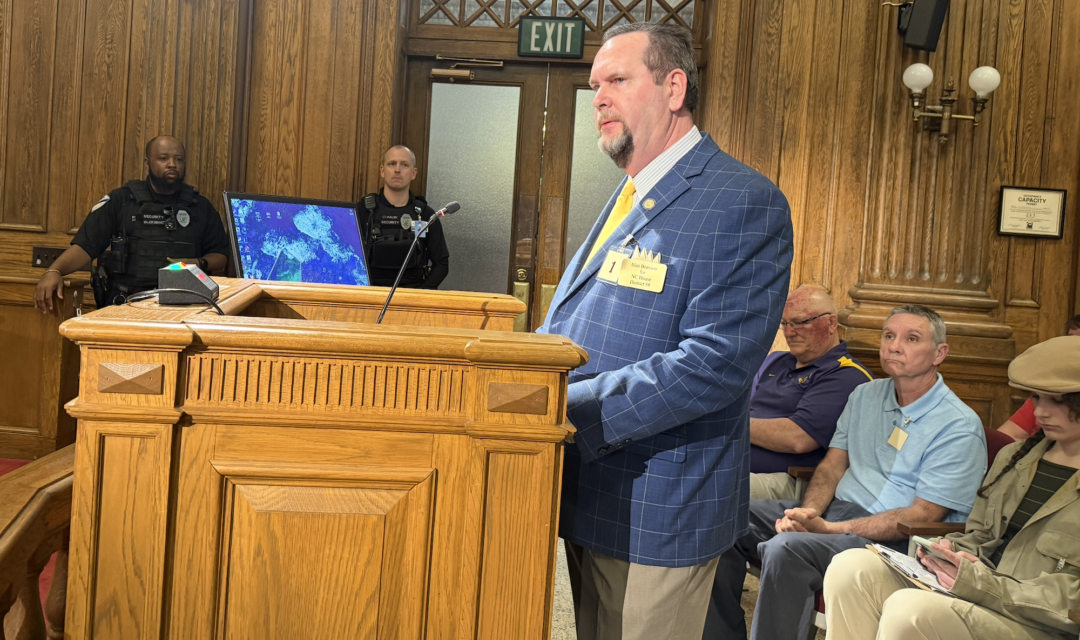
The first speakers was Branson (pictured above), who urged the board to adopt a revenue-neutral tax rate when the county sets its budget later this year.
Branson told commissioners he understood the challenges of balancing a county budget but said many residents are already struggling with rising costs.
“I completely understand the budget process here in Guilford County,” Branson said. “We all definitely need to fund all essential services – but I do feel there are many things that you will place in the 2026 budget that probably could be lessened or removed.”
Branson also said residents across the county are already facing higher costs for basic necessities.
“The citizens are struggling with increased cost of living – rising insurance, higher grocery bills, higher health care costs and many other items that are necessities,” he said.
Branson noted that property revaluation notices have recently gone out across the county and that many homeowners are seeing dramatic increases.
“All Guilford County citizens have received their tax appraisals and the majority of these appraisals have skyrocketed,” he said. “I’m hearing calls all over the marketplace from 30 to over 100 percent. My primary residence was up 59.6 percent.”
He said neighboring properties saw even larger increases.
“That is extremely ridiculous,” Branson said.
Branson warned that if the county leaves the tax rate unchanged after the revaluation, the county will automatically collect far more revenue.
That number, by the way, is $175 million.
“When our property values rise, the county brings in more revenue even if the tax rate stays the same,” he said.
“Again, I’m asking that you adopt a revenue-neutral rate,” he stressed.
Branson also warned that large increases in assessed values could hit businesses particularly hard.
“I’ve heard a rumor that business owners could also receive the largest tax increase of 100 to 300 percent,” he said. “We are already struggling to make ends meet because of higher costs of running our businesses. This could possibly cause many businesses to shut their doors.”
At one point Branson asked residents in the audience who were unhappy with their reassessments to stand.
The vast majority of people in the packed room rose to their feet. Many of those who did were older adults and the elderly.
The county’s property revaluation has triggered widespread concern across Guilford County because many property owners are seeing assessed values increase sharply compared to the last revaluation cycle.
However, higher property values don’t automatically mean higher taxes.
Property taxes are calculated by multiplying the assessed value of a property by the county’s tax rate. When property values rise sharply during a revaluation, local governments often lower the tax rate to keep overall revenue roughly the same.
That lower rate is known as a “revenue-neutral” rate.
State law requires counties to publish what the revenue-neutral rate would be, but commissioners aren’t required to adopt it. If the board sets the tax rate above the revenue-neutral level, the county collects more total tax revenue.
Several speakers referenced the county’s last revaluation cycle in 2022, when the board chose not to adopt a revenue-neutral rate.
County resident James Steber told commissioners his property taxes rose significantly during that cycle.
Steber said rising taxes eventually get passed along to renters.
“We’re not paying it – the property owners aren’t going to pay it,” he said. “They’re just going to pass it on to the renters. It’s a vicious cycle.”
Another speaker said many homeowners are experiencing “sticker shock” when they open their new assessment notices.
“My own property value increased approximately 49 percent,” the speaker said. “When property values rise nearly 50 percent but the tax rate stays the same, homeowners don’t experience this as a reassessment – they experience it as a tax increase.”
She urged commissioners to adopt a revenue-neutral rate.
“Reevaluation should reflect market conditions, but not become a mechanism for automatically increasing the tax burden on residents,” she said.
Many speakers described dramatic increases in assessed values.
Christi Bledsoe told the commissioners that her home’s value jumped nearly 180 percent.
“I feel like Guilford County has lost its mind,” she said.
Kelly Perdue said she’s on a fixed income and fears the new values could push her out of her home.
“I love Greensboro, but y’all are about to run people out of town,” she said. “I’m scared. I’m worried I’m going to lose my house.”
Retired county resident Louis Thibadeaux said his home’s assessed value jumped from about $160,000 to more than $300,000.
“My wife is disabled,” he said. “We need some help. It’s not just seniors – it’s everybody.”
One speaker nearly broke down in tears as he described the financial pressure many homeowners now face.
“We’re just regular people trying to work and make it happen,” he said. “The cost of living is way up from what it was just five years ago.”
Resident Linda Plummer told commissioners her property value had doubled and she said navigating the appeals process could be expensive and confusing. She said it was too expensive to get an appraiser in order to make her case to the county.
“I have three homes,” she said. “To do all three of them it’s going to be $1,200.”
Several speakers also warned that rising property taxes could damage the local economy.
New county resident George Tomasic said the reassessments reminded him of policies in other parts of the country where high taxes have driven residents away.
“This is not forward thinking,” he said. “This is short-term thinking.”
Drumright – who recently won a primary election for a seat on the Guilford County Board of Commissioners – said he understands both sides of the issue.
“I realize that it’s imperative that we do not place the entire burden upon the over-taxation of people – our local residents and our proprietors,” Drumright said.
He said many residents he met during his campaign are already struggling with rising living costs.
“People on fixed incomes are already suffering from the stress of stretching their budgets to meet the demands of the rising cost of living,” he said.
At the end of the lengthy public comment period, Chairman of the Guilford County Board of Commissioners Skip Alston thanked the speakers and encouraged residents to keep providing input.
“We really appreciate that,” Alston told the crowd. “We want to hear from you – this is not bothering us at all. This is what we want.”
Alston said commissioners still have a long process ahead before the tax rate is set.
He noted that the board must first review budget requests from county departments before holding a formal public hearing.
“We’ve got to hear from all of our departments and we’ve got to hear from all of you,” Alston said.
The official public hearing on the budget and tax rate will be held on Thursday, June 4, with the final vote scheduled for mid-June.
Until then, he told residents, commissioners want to keep hearing from them.
“When you come down here, that helps us,” Alston said. “We want you all to come – bring your neighbors.”




“When you come down here, that helps us,” Alston said. “We want you all to come – bring your neighbors.”
Read: We have our lists.
“We really appreciate that,” Alston told the crowd. “We want to hear from you – this is not bothering us at all. This is what we want.”
“… this is not bothering us at all…” Oh, thank you Mighty One, we certainly wouldn’t want to bother you TO YOUR JOB! Does your “…hear from all of our departments…” remark include all the NPOs on your list you finance WITH OUR MONEY?. That should be the FIRST thing cut. Does that include all the commissions, study groups, and other useless positions you create and finance.
Anybody know a bookie who is willing to give odds on the outcome of Skip the Omnipotence’s claim.
No bets here. You are a fool if you believe anything Skip Alston says. I don’t believe he will curtail any of his numerous pet projects that waste our tax dollars.
My thoughts exactly Alan. Remember a couple years ago when Skip himself decided to expand the county mwbe department from 1 1/2 people to 8 on his decision after the budget had been set. No input from the board or anyone else just skip. What do you think 8 full time positions plus benefits cost the taxpayers. 40 hours per week x 8 is 320 hours. I’d like to see the accountability and benefit to the taxpayers from that, plus don’t forget the cost to move them to their own office space down on Elm St. Then you have to include the up fitting as well as new furnishings.
Sarcasm abounds, and rightly so. Poly-speak sez don’t worry. Everything will be fine. I guess they’ll get their cue from the new Gov. of VA; with her dozens of sneaky stealth taxes, you should see the list.
Skip is full of white lies and always has been. When was the last time he actually did anything without a bunch of useless political fodder and lollygagging? The answer is NEVER!
These Commissioners may say they hear the requests and appreciate them but they are going to do exactly what they want to do.
ditto
The political process at work. Well done GC! Speaking up / protesting works. Keep it up and you have a chance.
it wont work on skip but i wish it did. we need folks in there who will actually give a dang about their constituents
Fair comment. But never give up.
poor girl ! ‘she has three homes’ . . .
yeah like skippy cares about his constituents…all this “we love hearing your voices” is a bunch of empty crap. it’s reverse psychology i tell you. he always knows how to manipulate his audiences. all he wants to do is raise your taxes and hes avoiding the real questions by saying “thanks.” how ironic
we need to get some real commissioners that actually care about their constituents. i rather have an honest commisioner who doesnt care than one who lies to your face like that dang skip alston
It’s not what they say, but what they do.
ONCE AGAIN Skippy and his LIBERAL CRONIES are flooding our commissioner meeting with empty thanks! We all know that Skip doesn’t care ONE BIT about his constituents. It is clear as day that all he wants is a promotion. The sooner he can get out of these meetings where he has to listen to his constituents the better.
And then comes the usual performance. Skip sitting there acting like HE’S the calm reasonable one, thanking everyone, saying he wants to “hear from you,” saying it “does not bother us at all.” PLEASE. Anyone who has watched this circus for more than five minutes knows EXACTLY how that works. Smile for the cameras, say the polite thing, and then keep the machine rolling exactly the way it was already rolling.
Everybody knows the type. The career politician who is always looking at the NEXT office, the NEXT title, the NEXT rung on the ladder. The meetings, the public comments, the citizens speaking their minds, that is just background noise he has to tolerate on the way to wherever he thinks he is headed next.
Enough of this stuff will drive Skip mad so keep at it until we can vote him outta here.
Not until the conservatives decide to show up at the polls, which ain’t been happening. I got out of the County, with much regret as Greensboro is my home town.
Get out of Guilford County!
Skip Alston says it’s not bothering him at all to hear from residents but did he get the message?
No Peter what Skip said was thanks for coming next time bring your neighbors so everyone can get their Vaseline equally.
Maybe this time though Alston’s base back in district 8 is paying attention too. Term limits and countywide elections solve this
We already have term limits, but the voters are unwilling to use them.
You are right. The apathetic and informed voter is the problem. Use it, or lose it. Adios Republic.
84.95% relative to the required 85%
There is no “rounding up or down ” language in the NC statute citing the 85% threshold.
However, tax calculations by IRS standards do indeed round when filing taxes.
So. Is it EXACTLY 84.95% or is it 84.951%
The upper end is 1.15 or 115%
Range = 0.85 to 1.15 per NC statute.
Does anyone know the legalities of not rounding up from 84.95 to 85%
What is the statutory standard for the 85%?
———–
Alston’s oleaginous obsequiousness is as ephemeral as it is transparent, as he is faced with a room full of angry (white) citizens.
He’ll stick it to us. That’s the whole point.
Quit using them durn adjectives. The only oleo I know is not butter.
————-
Sorry.
You can take the boy out of the English Public School, but you can’t take the English Public School out of the boy.
[ “Public School” in Britain means a secondary school that’s a private institution, and carries connotations of academic excellence and strict moral standards. I was a victim. Er, I mean pupil. ]
austin, wut are other options there ? (unnecessary ‘?’ added just 4 u). yesterday’s WSJ front page article highlights our conflict over ‘spelling, grammar & punctuation’. my style connotes ‘power’. suk on it
Yes, Taxpayers sent a loud and clear message to our commissioners.
Question- Are the commissioners truly listening to the citizens of Guilford County? If not, no matter the party that commissioner needs to go.
politicians are obligated to represent their constituents after all
I Googled corporate investment in the North Carolina housing market. Sources: Federal Reserve Bank, Charlotte Urban Institute. Here is what I found:
Legislation is on the US Senate floor this week…
Specific, up-to-date data on the exact number of homes owned by private equity firms solely within Guilford County, North Carolina, is not explicitly detailed in recent, publicly available studies. However, available data indicates a significant presence of corporate investors in the region, particularly within the neighboring Charlotte-Mecklenburg and Research Triangle areas.
Private Equity Stakeholder Project PESP
Private Equity Stakeholder Project PESP
+1
Regional and State Context
North Carolina Presence: As of late 2022, about 20 companies held at least 40,000 single-family properties in North Carolina.
Triad Exposure: While the highest concentrations are in Charlotte and Raleigh, major private equity-backed firms like Progress Residential own properties across the Triad region, which includes Greensboro and High Point in Guilford County.
Investor Share: In the broader North Carolina market, corporate investors are highly active, with some estimates showing they own 8.8% of investor-owned single-family homes.
Apartment Ownership: Private equity firms own at least 20% of apartment units in North Carolina, according to 2025 reports.
Federal Reserve Bank of Richmond
Federal Reserve Bank of Richmond
+4
Impact on Housing in the Area
Market Share: While large institutional investors (those owning 100+ homes) own a smaller share of the nationwide market, their impact is significantly higher in Sunbelt metros like those in North Carolina.
Investor Activity: In the first quarter of 2025, investors purchased nearly 27% of all homes sold nationwide, with similar high-interest trends observed in NC.
Local Impact: In similar regions, such as Mecklenburg County, corporate investors (owning a minimum of 15 properties) increased their market share from 5% to 7.5% between 2019 and 2023.
Charlotte Urban Institute
Charlotte Urban Institute
+2
While no definitive “number of homes” is publicly cited for Guilford County alone, the high concentration of corporate landlords in NC suggests thousands of single-family units in the Triad area are held by such firms.
Please Address the Below;
WHO MADE THE BELOW, PUBLISHED MISTAKE THURSDAY MARCH 5th?
“Alston added that the official public hearing on the budget and tax rate will be held on Wednesday, June 4, with the final vote scheduled for mid-June.”
WEDNESDAY JUNE 4th WAS LAST YEAR.
JUNE 4th IS A THURSDAY IN 2026. SO, IS THE MEETING WEDNESDAY JUNE 3rd, OR THURSDAY JUNE 4th, OR WAS THE MEETING LAST YEAR?
PERHAPS SKIP HOPES NOBODY COMES BECAUSE THEY WERE PROVIDED THE WRONG DATE?
Skip misspoke. It is Thursday, June 4. Good catch
—————-
Skip…?
In Guilford County, Joe Biden received 61.6% of the vote in 2020 and Kamala Harris received 60.0% in 2024. Probably the two dumbest people ever to run for President. I do not understand it, but it is what it is and if you think the libs on the commission are going to change their ways or you think over 10% of the county will wise up you are the definition of insanity. Either deal with it or move.
I have no problem having a higher valuation of my property.it’s great when you sell as Mr. Chavis says. But if the tax rate isn’t reduced, that idea doesn’t help me or anyone pay the additional tax!! In the last five years, property taxes, utilities , property and casualty insurance, groceries, and basically everything else has gone up. The county has already failed to use the last bond referendum money efficiently resulting in only half the school projects being able to be finished. Skip now wants another $500 million to finish those! Hood luck!! Have the commissioners ever thought of tightening their belts like everyone and every business has to do before asking for money??? I have always voted for the 1/4 cent sales tax requested and against only one bond issue! The school bond request of1994(year?). The reason then because we were promised that the school consolidation of Guilford County would save the taxpayers money. It didn’t and the bond was voted down which was unfortunate but the taxpayers didn’t like to be fooled!! Thus, Skip and the rest of the commissioners , reduce the rate and trim your expenses even if it means layoffs of personnel!!!
I have some information that might be useful in your arguments for keeping property taxes at a neutral rate. If you check the following link you will see a trove of useful information about NC Counties:
https://www.commerce.nc.gov/news/the-lead-feed/nc-counties-10-findings-new-county-economic-vitality-index
This information shows which Counties are doing best (by exceeding the National average) which are gaining or losing, which are struggling, etc. Guilford is hardly the worst but is clearly subpar.
I have also analyzed the combined City/County property tax burdens (using the largest city in each county) of the 11 Best Performing Counties in the link. The average combined rate in these outstanding counties is 1.02. Of these 11 counties, the two listed as “Waning” (Camden and Orange) also bear the two highest combined rates (1.32 and 1.39) and if these are removed from the calculation the average combined rate is 0.95. Another comparison is that Charlotte and Raleigh, the only cities larger than Greensboro, have an average combined rate of 0.97 (0.73 and 1.09) The point of all this is that high property tax rates appear not to improve but rather may harm the economic prospects of cities and counties that impose them.
Guilford/Greensboro is ten points under the US National average for economic vitality. It also is far behind the highlighted County/City pairs in the NC Study, and it also has a higher combined tax rate than any of the top 11, and much higher than the average combined rate of the 11. While this does not prove that higher property taxes reduce economic vitality, it does seem to at least demonstrate that higher rates do NOT INCREASE economic vitality.
Finally as to the argument that we must subsidize growth, why not have the growth subsidize the existing residents? If the growth does not pay for itself, then what is the point? The purpose of taxes is to benefit the entire community, not to impoverish some members to enrich others. Bigger is only better if everyone is also better. Local government should serve the locals first.
Interesting article. Thanks for sharing.
ditto chris
After property taxes were increased by 78% to 237% recently, minority taxpayers in Chicago burned their tax bills in the street because they wanted to do more than just speak up a city council meetings to deaf city council members.
I wonder why ole skippy and the democrats who control the county, the Greensboro city council, the city of High Point and every other governmental entity are so incredibly unconcerned about high taxes. In the 10 years I have lived here, my property taxes have doubled just like almost everyone else. We left Chicago because we were tired of high taxes, crime, and one party control of every government by crooked democrat politicians. We lived in Cook County which everybody in Illinois knows is pronounced CROOK county. Guilford county is now looking like Crook county because both are controlled by democrats and crime, high taxes, under performing schools and a detouring downtown are driving people away.
ole skippy says the county will not need all of the $175 MILLION dollars that will be generated if the property tax mill rate is not changed. How thoughtful of him. How about the democrat controlled county board, the city councils in Greensboro, High Point and every other governmental entity LOWER THE MILL RATE so taxpayers are not forced out of their homes by higher taxes.
Let’s not forget the $1.7 BILLION school bonds that voters approved even though a Wake County democrat judge ruled that Guilford County and the school board ILLEGALLY worked together to promote the bonds. Several months after the bonds were approved, ole skippy and the Guilford controlled county board FINALLY admitted taxpayers will have to pay back $3.4 BILLION for the bonds. Bonds must be spent within 10 years of approval and repaid within 20 years of when the money is spent. S-o-o, for the NEXT 30 YEARS taxpayers will be paying $113 MILLION a year to repay the school bonds. Gee, I wonder why ole skippy and the democrat controlled county board and democrat school board HID THE TRUTH FROM VOTERS AND GIVE THEM TOTAL COST? Do you suppose if voters and taxpayers would have approved the bonds if they knew the full total cost? I don’t think so either.
Now ole skippy and the democrat controlled county board want to spent $572 MILLION for a new county office complex AND borrow another $550 MILLION for the schools. When added all together, Guilford taxpayers will be paying over $200 MILLION a year for the 2 school bonds and the county office complex. Just remember that the BANKS GET PAID FIRST before any money is spend on police, fire, EMT, and every other expense of running the county.
Then we have old skippy’s 4th or 5th attempt to RAISE SALES TAX that will bring in another $20+ MILLION a year. The thing is that if approved by voters, it will never go down as long as long as democrats control the county board.
You can also bet your very last dollar that sometime in the next 30 years, ole skippy and his merry band of tax and spend democrat cult members (county commissioners) will borrow money time and time again. This will keep all of us toiling in Guilford just like share croppers toil on land they will never own.
What kind of financial legacy are you leaving your kids and grand kids? I thought parents wanted to leave their kids in better shape when they leave this world! At this rate, current taxpayers and voters will be putting their kids in debt up to their eyeballs. WHAT THE HELL IS GOING ON HERE FOLKS??? IS THIS REALLY WHAT YOU WANT TO LEAVE YOUR KIDS? DO YOU REALLY WANT TO LEAVE THEM IN WORSE SHAPE THAN YOUR PARENTS LEFT YOU? WHAT KIND OF PARENT WOULD WANT THAT?
250 years ago, citizens of our nation were fed up with the British tyranny and their excessive taxes. All the British did was to tax, tax, and tax some more. Looks like it is time to VOTE TO GET RID OF THE DEMOCRAT TYRANNY! WAKE UP PEOPLE!!!
One of the lines from the 1976 movie Network News, one of the lines was ‘I am mad as hell and I am not going to take it anymore’. Well NOW IS YOUR TIME TO ECHO THAT SENTIMENT AND TO TAKE ACTION! VOTE FOR EVERY REPUBLICAN IN EVERY OFFICE FROM DOG CATCHER TO GUILFORD COMMISSIONERS, TO CITY OFFICIALS, TO JUDGES, TO REPRESENTATIVES AND SENATORS IN RALEIGH AND IN WASHINGTON!
SEND THE DEMOCRATS TO THE TRASH HEAP OF HISTORY WHERE THEY BELONG. If you don’t, dems will continue to take every penny out of your pocket, and the pockets of your kids and then tax the lint they left behind.
IT IS YOUR CHOICE. DO YOU WANT FREEDOM OR ARE YOU CONTENT TO CONTINUE BEING A SLAVE TO TAX AND SPEND DEMOCRATS? JUST REMEMBER, THE CHOICE YOU MAKE TODAY WILL BE THE CHOICE YOU ARE MAKING FOR YOU KIDS AND FUTURE GENERATIONS.
Hey commish! Can you imagine the digit?
yes miller, it’s on my prostate
After property taxes were increased by 78% to 237% recently, minority taxpayers in Chicago burned their tax bills in the street because they wanted to do more than just speak up a city council meetings to deaf city council members.
I wonder why ole skippy and the democrats who control the county, the Greensboro city council, the city of High Point and every other governmental entity are so incredibly unconcerned about high taxes. In the 10 years I have lived here, my property taxes have doubled just like almost everyone else. We left Chicago because we were tired of high taxes, crime, and one party control of every government by crooked democrat politicians. We lived in Cook County which everybody in Illinois knows is pronounced CROOK county. Guilford county is now looking like Crook county because both are controlled by democrats and crime, high taxes, under performing schools and a deteriorating downtown are driving people away.
ole skippy says the county will not need all of the $175 MILLION dollars that will be generated if the property tax mill rate is not changed. How thoughtful of him. How about the democrat controlled county board, the city councils in Greensboro, High Point and every other governmental entity LOWER THE MILL RATE so taxpayers are not forced out of their homes by higher taxes.
Let’s not forget the $1.7 BILLION school bonds that voters approved even though a Wake County democrat judge ruled that Guilford County and the school board ILLEGALLY worked together to promote the bonds. Several months after the bonds were approved, ole skippy and the Guilford controlled county board FINALLY admitted taxpayers will have to pay back $3.4 BILLION for the bonds. Bonds must be spent within 10 years of approval and repaid within 20 years of when the money is spent. S-o-o, for the NEXT 30 YEARS taxpayers will be paying $113 MILLION a year to repay the school bonds. Gee, I wonder why ole skippy and the democrat controlled county board and democrat school board HID THE TRUTH FROM VOTERS AND GIVE THEM TOTAL COST? Do you suppose if voters and taxpayers would have approved the bonds if they knew the full total cost? I don’t think so either.
Now ole skippy and the democrat controlled county board want to spent $572 MILLION for a new county office complex AND borrow another $550 MILLION for the schools. When added all together, Guilford taxpayers will be paying over $200 MILLION a year for the 2 school bonds and the county office complex. Just remember that the BANKS GET PAID FIRST before any money is spend on police, fire, EMT, and every other expense of running the county.
Then we have old skippy’s 4th or 5th attempt to RAISE SALES TAX that will bring in another $20+ MILLION a year. The thing is that if approved by voters, it will never go down as long as long as democrats control the county board.
You can also bet your very last dollar that sometime in the next 30 years, ole skippy and his merry band of tax and spend democrat cult members (county commissioners) will borrow money time and time again. This will keep all of us toiling in Guilford just like share croppers toil on land they will never own.
What kind of financial legacy are you leaving your kids and grand kids? I thought parents wanted to leave their kids in better shape when they leave this world! At this rate, current taxpayers and voters will be putting their kids in debt up to their eyeballs. WHAT THE HELL IS GOING ON HERE FOLKS??? IS THIS REALLY WHAT YOU WANT TO LEAVE YOUR KIDS? DO YOU REALLY WANT TO LEAVE THEM IN WORSE SHAPE THAN YOUR PARENTS LEFT YOU? WHAT KIND OF PARENT WOULD WANT THAT?
250 years ago, citizens of our nation were fed up with the British tyranny and their excessive taxes. All the British did was to tax, tax, and tax some more. Looks like it is time to VOTE TO GET RID OF THE DEMOCRAT TYRANNY! WAKE UP PEOPLE!!!
One of the lines from the 1976 movie Network News, one of the lines was ‘I am mad as hell and I am not going to take it anymore’. Well NOW IS YOUR TIME TO ECHO THAT SENTIMENT AND TO TAKE ACTION! VOTE FOR EVERY REPUBLICAN IN EVERY OFFICE FROM DOG CATCHER TO GUILFORD COMMISSIONERS, TO CITY OFFICIALS, TO JUDGES, TO REPRESENTATIVES AND SENATORS IN RALEIGH AND IN WASHINGTON!
SEND THE DEMOCRATS TO THE TRASH HEAP OF HISTORY WHERE THEY BELONG. If you don’t, dems will continue to take every penny out of your pocket, and the pockets of your kids and then tax the lint they left behind.
IT IS YOUR CHOICE. DO YOU WANT FREEDOM OR ARE YOU CONTENT TO CONTINUE BEING A SLAVE TO TAX AND SPEND DEMOCRATS? JUST REMEMBER, THE CHOICE YOU MAKE TODAY WILL BE THE CHOICE YOU ARE MAKING FOR YOU KIDS AND FUTURE GENERATIONS.
————
Hear, hear!
It’s time for something radical.
Our pocketbook is under attack from everywhere. Govt, big business, insurance, food, etc. You name it.
I have an example of “dynamic pricing”. Charging different pricing based on your own buying habits, place and time of day, etc. You can see that example where some businesses have a big monitor showing their prices, or search your ID and your Dumbphone as you walk in.
I order an item from Amazon this AM, along with some others. One item was priced @ $21.45. My wife has her own account, as she had purchased the same item before. Her price now? $22.84. $1.39 or 6.5% more. That is dynamic pricing.
Amazon is not your friend. Amazon is your Big Brother.