


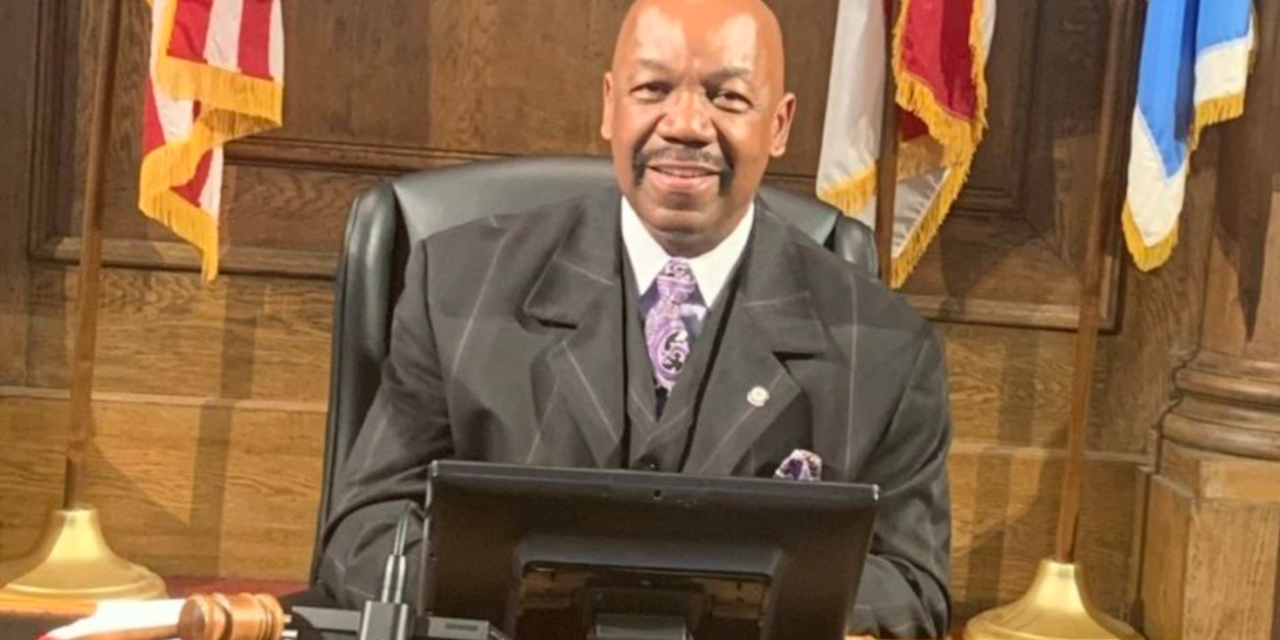
On Thursday, Dec. 4, Chairman of the Guilford County Board of Commissioners Skip Alston will be voted into that role for another year.
When the board gathers for its annual “organizational meeting,” the Democratic-majority board will do what it’s done year after year – get behind Chairman Skip Alston and hand him another 12 months leading the county’s most powerful governing body.
Alston isn’t just chairman again – he’s running up the score.
He’s already served as chairman ten times, more than twice as often as former chairmen Wally Harrelson and Bob Landreth, who each held the job four times. This will mark Alston’s eleventh term in the center seat on the dais – extending a record that already makes him by far the longest-serving chairman in Guilford County history.
The Rhino Times has taken to calling him “chairman for life,” and one reader recently simply labeled him “King of Guilford County.”
Alston is a Durham native who studied business administration at North Carolina Central University before moving to Greensboro in 1979.
He built a real estate career here, founding The Alston Realty Group, which now manages a large portfolio of local properties. He has represented the county’s District 8 on the Board of Commissioners since 1992 – with a brief hiatus of a few years – and, in 2002, he became the first African American chairman of the board.
That was a milestone Democrats still point to when they talk about his legacy.
Outside of county government, Alston’s name is permanently tied to the International Civil Rights Center and Museum in downtown Greensboro. As a county commissioner in the early 1990s, he pushed to save the old Woolworth’s building where the Greensboro sit-ins began and he co-founded the non-profit that ultimately created the museum – a project that took years of fundraising battles, political fights and financial controversy to get across the finish line.
Over the years, local media have often described him as a “colorful and controversial” figure, and, at one point, a news outlet editorial called for him to step aside from the museum’s leadership to restore public confidence. The museum survived, and Alston’s role in creating it remains a major piece of his public resume.
In recent years, he has tried to wrap his county leadership in the language of unity: His 2025 State of the County address, delivered recently in the commissioners’ meeting room in the Old Guilford County Court House, carried the theme “One Guilford: Measuring Our Success, Planning Our Future” – a slogan meant to cast county government as data-driven, collaborative and focused on outcomes rather than traditional partisan bickering.
Alston himself argues that he tries to lead a nonpartisan board. In interviews, he has pointed to times when he has worked with Republicans to avoid tax increases and restructure county leadership – and he often notes that the current board “very seldom” votes on party lines.
He likes to remind people that Republican commissioners such as Alan Perdue and Pat Tillman regularly get projects for their districts.
Still, he has always been a hard-nosed politician who knows how to get and count votes. The Democrats hold a firm majority on the board and, as the Rhino has reported for years, they rarely break with him on major questions – including who sits in the chairman’s seat. In fact, in the last five years, the Rhino Times can only recall a few times when Democratic commissioners have not voted with him. (Not counting the “Democratic” commissioner about five years ago who was actually a Republican and who stepped down from the board.)
During Alston’s time as chair, the board backed a $300 million school bond in 2020 and a $1.7 billion school bond in 2022 – one of the largest local school bond packages in state history. Total school debt service is now projected to exceed $3 billion by the time the borrowing is paid off. County documents show that tens of millions of dollars in annual property tax revenue are already earmarked just to pay those bills, and county officials admit the debt will force some tough decisions in the years ahead.
Alston has also put himself at the center of the county’s growing housing crunch. This summer, he convened what he described as a major meeting of builders, planners and other industry leaders in the Carolyn Coleman conference room in the Old Guilford County Court House to talk through projections that showed Guilford County will need roughly 97,000 new housing units over the next five years in order to keep up with expected growth. He has called for a larger summit with mayors, city managers and developers to attack permitting delays and other bottlenecks – arguing that the county must move faster if it wants to be ready for the flood of new jobs coming from companies like JetZero and other big employers that are now landing in the area.
On top of all that, Alston is once again climbing the ladder of state-level influence: Earlier this year he was chosen as vice chairman of the North Carolina Real Estate Commission – the board that licenses and regulates real estate brokers across the state. He’s widely expected to move back into that chairman’s role too, which he previously held in the mid-2000s. If that happens, the same man who chairs the board that sets Guilford County’s property tax rate would also chair the commission that oversees the real estate industry statewide.
To his admirers, especially among local Democrats and civil rights leaders, his resume is exactly why he keeps getting the votes. They see someone who’s helped save an international civil rights landmark, co-founded a museum that draws visitors from across the world, led the state and local NAACP, and uses his political clout to direct investment toward long-neglected neighborhoods. They credit his long tenure with pushing for affordable housing, expanding county services and making sure that District 8 has a loud voice at the table.
To his critics – and there are a whole lot of those in Guilford County – Alston is something else entirely: Many conservatives regard him as the ultimate insider, accuse the board of tax-and-spend politics and argue that one man has held the gavel for far too long.
Some property owners blame him personally for tax bills rising after the school bonds and the countywide revaluation. Others still bristle at the long financial controversies surrounding the civil rights museum.
Among his opponents, the phrase “king of the county” isn’t meant as a compliment any more than Trump critics consider calling him a king a compliment.
With billions in school debt coming due, a housing shortage looming and a wave of new industry arriving, Guilford County is headed into a complicated 2026 and will face a lot of new challenges. But the man leading the county will not be new at all.
The Who sang it best: “Meet the new boss, same as the old boss…”




Skip Alston’s company manages over $40 million in properties. Talk about getting rich while in office. In the meantime, he is one of the main reasons that Guilford County government has grown bigger and the tax burden on Guilford county residents, both property owners and renters, has grown very large and burdensome. 2026 will be no different with county property revaluations going up about 50% resulting in homeowners property tax annual payments potentially going up thousands of dollars. He gets rich and we pay the price while Democrat county leadership continues to just smile and agree and back him. Pottersville awaits our future.
There again ANOTHER CROOKED DEMOCRAP USING THE WOOLWORTH BUILDING TO KEEP HIS ASS UP
ATTENTION !!! ATTENTION!!! ATTENTION SUBJECTS OF THE FIEFDOM GUILFORD COUNTY!!!
On December 4th in the year of our Lord Alston’s rule there will be the official Coronation of His Greatness by the Counts and Countesses of his Board of County Commissars.
Due to the anticipated increase of your mandatory donations (aka taxes) no gifts will be required.
Genuflecting will be optional.
I would ask you to tone it down a little PH, but I was laughing too hard and honestly could type that with a straight face.
Pray he doesn’t alter our taxes upward any further.
You can count on Emperor “Tax and Spend” Skippy to keep Guilford County taxes high and never lower the tax rate when property values get reevaluated this year.
Skip is my favorite reason that I don’t live in Guilford County anymore.
I puked…twice.
There AGAIN ALSTON A CROOK BEEN STEALING FOR DECADES
You’re correct Scott, “ Alston has also put himself at the center of the county’s growing housing crunch”. Were he not so racist he should step back and let the free market answer this slow development of new housing, (if you build it they will come) but just as he played the race card during construction of the Sherriff’s’ new digs, he insists on exerting influence over the real estate market in Guilford County to the point that he wants to influence what price new housing should cost, and where it’s built.
Unfortunately this bully rolls on, voter apathy insures his place in Guilford County government.
If people who call PRESIDENT TRUMP A DICTATOR want to see a REAL DICTATOR UP CLOSE AN PERSONAL…LOOK NO FURTHER THEN ole skippy AND THE democrat controlled county board and school board. You can throw in the city governments of Greensboro and High Point too.
dems spend, raise taxes, spend, raise taxes (repeat, repeat). It is a never ending circle of padding their own wallet first at taxpayer expense. dems hand out YOUR MONEY to their friends and co-conspirators first, and then say they need more of YOUR MONEY. A few years ago ole skippy and the democrat controlled county board gave themselves a 50% PAY RAISE. Then, not to be outdone, the democrat controlled High Point council gave themselves an 88% PAY RAISE; raised property taxes by 5%; gave the City Manager and Attorney a 12% raise; INCREASED water rates by over 13% in two years (with higher rates in the next budget) and now are considering giving up to $7,500 for down payment assistance to the 1,400 (or so) city employees. This give away could cost taxpayers $10.5 Million. ole skippy must be so-o-o proud of his cult members. Don’t forget ole skippy wants another $550 Million for schools AND he WANTS TO INCREASE THE SALES TAX! Just so you know, the existing $2 BILLION school bonds will cost over $3.4 BILLION and must be paid back within 20 years after the money is spent. So-o-o, when taxpayers were tricked into supporting the bonds, ole skippy and his fellow cult members failed to tell taxpayers it will cost them over $102 MILLION dollars just to pay off the bonds and that is BEFORE taxpayers fund the school system. THIS IS A HUGE GRIFT.
HP mayor Jefferson now is running for a higher office promising to bring his undeniable liberal tax and spend policies to what he hopes will be his next higher office. Jefferson is a want to be clone of dictator ole skippy. Taxpayers can’t afford dictator ole skippy and dems like jefferson. TIME TO THROW OUT ALL DEMS. If you want to see just how high your taxes will be….just watch dictator ole skippy and his crew of dictators who are slaves to his whims. IF YOU WANT LOWER TAXES AND MORE TRANSPARENT GOVERNMENT…VOTE FOR REPUBLICANS FOR EVERY OFFICE from dog catcher, to city council members, to county offices, to judges, to state elected officials and federal officials.
Remember it was REPUBLICAN AND CONSERVATIVE PRESIDENT TRUMP who eliminated taxes on Social Security, tips and overtime. If dems think PRESIDENT TRUMP is a dictator, where can we find another CONSERVATIVE LIKE TRUMP and how fast can we get the person elected!
There AGAIN ALSTON A CROOK BEEN STEALING FOR DECADES
Skip Alston’s resume does not include results. The museum came about through taxpayer money and Alston strong-arming businesses and politicians, not through his hard work and ingenuity, unless shakedowns are considered hard work. Somehow, Alston was able to acquire an entire city block surrounding his museum. How did that happen? And the museum remains an albatross around taxpayers’ necks. As for yearly visitors to the museum, open your books, Skippy, and let the people paying for your museum see what they are paying for. As far as investment is directed at long-neglected neighborhoods, show us the investments. Pushing for affordable housing does not mean results. Show us the affordable housing Alston has created. Alston is all show and no substance. Results are what matters. The property tax money that Alston spends as if it is his own money comes not from District 8, but it is District 8 that assures he is re-elected time and time again. That’s why we need term limits.
Concerning the Civil Rights Museum, I have heard that tax payers are charged per visitor when school children visit while in school. Make sure he forsnot include school children in tge total count of visitors since this is on the backs to tax payers as well.
Pottersvville why bother to ask, you will never get hard answers about the number of visitors, donations, employees salaries or taxpayer dollars involved with the money pit.
Why? Because it is important to continue to ask repeatedly as a reminder that the museum is not forthcoming, which suggests deception, and politicians protect Skip Aston and the museum. Taxpayers should not be forced to finance a museum that cannot survive without taxpayer money.
Scott, there is a need to know if Pottersville’s comment regarding taxpayers paying for schoolchildren to visit the museum.
I will look into it.
Skip away with your money Alston… Once again he is King of the County. Say goodbye to your money, your land and your sanity. Say hello to racism, higher taxes and stealing.
No one should be in that position of power for so long. Skip is the best arguments for term limits.
Skip will be in office as long as he wants to be due to voter apathy and A and T student voters. By the way, these students come in from different parts of the country and are allowed to vote in our local elections. Hello!
PACLOC,
That is a practice I’ve pointed out before. Imagine how much closer we could get to REAL representation on the County and City level if these temporary County/City ‘citizens’ were restricted from voting in local elections.
Que Chrissy and his baseless whining about ‘fair’ elections. A complaint from someone who doesn’t even live in the Fiefdom of Skippy.
Skip-the-Hyp needs to get a grip on himself and give up the grip on the taxpayer.
Vote them ALL out at the earliest opportunity.
bon chance