

Guilford County held its Tuesday, Oct. 7, 2025, primary municipal elections – and the results are a stark reminder that, when it comes to only local politics, the vast majority of people simply don’t show up.
When 111 of the 113 precincts in the county finished reporting late Tuesday night , the tally was 22,208 ballots cast out of 210,515 registered voters – a turnout of right at 10.5 percent.
There were 15,328 people who showed up on Election Day; 6,717 voted early, 144 absentee ballots were cast, 19 were in the supplemental category and 5 provisional ballots joined the fray.
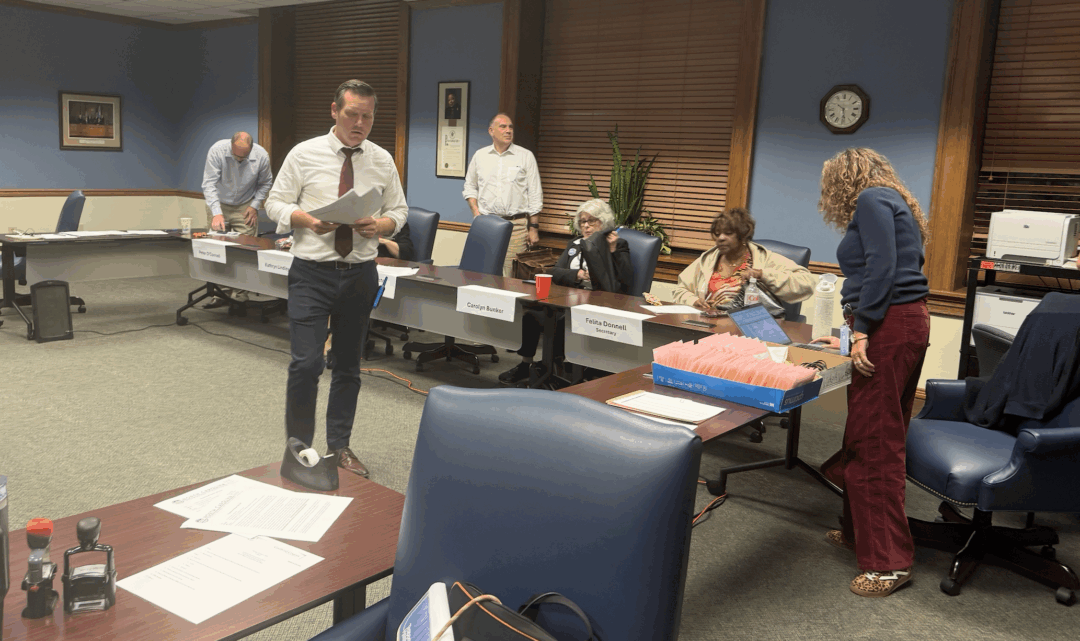
While votes were being tallied Tuesday night, the Guilford County Board of Elections was in session in the Carolyn Q. Coleman Conference Room of the Old Guilford County Court House. Board of Elections Director Charlie Collicutt said the board, that night, was able to address some of the provisional votes cast. That is, the board decided whether some votes should count or not when those ballots were cast with questions hanging over them.
The turnout was low, even for a primary.
Over the past two decades, primary turnout in Guilford County and across North Carolina has tended to hover at embarrassingly low levels – popping a little in presidential year primaries but sputtering in midterms, with most off years falling below double digits.
Taking the statewide view makes the trend clear: In the May 2022 statewide primary, the turnout was 31 percent of eligible voters.
In 2018’s midterm primary, turnout was around 14 percent.
In 2014, it was about 16 percent.
In other words, only in rare circumstances does turnout crack the 20 percent mark in midterm primaries in the state.
So, the 10.5 percent in Guilford in 2025 is grim – though not totally out of character for low‐interest contests.
Here are a few more points for reference:
In 2020, the statewide primary drew 31 percent of eligible voters.
In 2016, with presidential contests bringing more people in, the primary turnout statewide was 37 percent.
In midterm primaries – like 2018 and 2014 – the turnout languished in the low to mid-teens.
On the general election side, turnout is usually a whole lot better – though it’s still volatile.
In North Carolina, general election turnout has ranged from roughly 40 percent to 50 percent in nonpresidential years and been in the high 60 percent to 70 percent range in presidential years.
However, primaries, like Guilford County’s October 7 one, are clearly mostly for the political diehards.
The pattern suggests that, for most voters, the primary isn’t worth showing up to unless there’s a big, hotly contested race or some major bond referendum – like a school bond – on the ballot.
That means that many of the local contests in Guilford County are being decided by a small fraction of the electorate – as was the case Tuesday night. The people who did vote in this primary tended to be the ones who are heavily engaged — party loyalists, activists or those who are plugged into political networks.




Was it voter apathy? Municipal elections often see low turnout, but this time it felt different. I saw strong Democratic engagement — groups like Blac PAC and Guilford for All were out in full force, handing out voter guides at polling sites and even on the college campuses.
But where was the support from Guilford County Republicans? There were no Republican lists, no visible outreach at key locations. It raises real questions: Was this a case of voter disengagement, where Republican voters didn’t feel energized or informed? Or was it a lack of coordination and mobilization?
Either way, if we want balanced representation, we need to show up — not just at the polls, but in the streets, on campuses, and in conversations. Or is it the leadership in the Guilford GOP that is the issue? We need new leadership. Chris Meadows is not during a good job leading.
Chris Meadows Need to Resign
The concerns raised in this reflection are valid and timely. Leadership in any political organization must be measured not by titles held, but by presence, coordination, and principled engagement. The absence of voter guides, visible outreach, and strategic mobilization from Guilford County Republicans during this election cycle is not just disappointing—it’s revealing.
Municipal elections require intentional effort, especially when turnout is historically low. While Democratic organizations showed up with clarity and coordination, the Republican presence was fractured and silent. That silence speaks volumes.
If leadership , specifically Chris Meadows,
cannot mobilize, defend its placements, or engage voters with integrity, then it must be questioned. Accountability is not optional—it’s foundational. The call for new Guilford GOP
leadership is not a personal attack. It’s a principled demand for visibility, strategy, and respect for the voters who deserve better.
so 10.5% of voters with interest & information will govern. sounds like democracy to me where MINORITIES rule because of affluence, time available & education, are piloting our great ship of culture. i think every form of guvmnt is minority rule eg 2 parents 5 kids. ‘silence speaks volumes’ because every time they open their mouths (exhort) is evidence against them.
I agree with the concerns raised. Chris Meadows needs to step down. Leadership must be visible, coordinated, and accountable—especially during elections. The absence of outreach and voter engagement reflects a deeper failure in strategy and responsibility. Also we need to support our Republican candidates and that is not happening under his leadership.Change is not optional. It’s overdue.
Steve,
You have no clue. How many Guilford County Republican meetings have you been to in the past year? The Guilford County GOP had 66% of Republicans come out in early voting in 2024 and a total of about 83% of all Guilford County Republicans come out in the entire election in 2024.
2025 as an off presidential election year is just tough, but Guilford County Republican HQ put forth quite a bit of effort to get voters and volunteers out. I am not going to divulge strategy here, but we would like to have you volunteer and help in tge effort to recruit volunteers. Go to the GOP web site and sign up!!
Thank you for the invitation to volunteer, but the concerns raised are not about attendance at meetings—they’re about visible leadership and strategic presence during the election. Voters don’t measure impact by internal metrics from 2024. They measure it by what they saw at the polls in 2025.
Democratic volunteers were present, organized, and equipped—even in the rain. Republican visibility was fractured. Candidates were floated without support, and voters were left without clear guidance. That’s not just a tough year—it’s a failure of coordination.
In September, Jamilla Pinder was included in the newsletter along with all republicans running in the municipal race as a candidate to support. Republican voters received clear guidance to uplift her. Then, without explanation, an email was sent instructing voters not to support her—despite her presence on both the Democratic and Blac PAC lists.
This contradiction created confusion, fractured trust, and confirmed what many already suspected: leadership was not coordinating to uplift Republican candidates. Instead, it floated placements, then reversed course—without accountability. Many voters were left confused.
The sample ballot posted online was a mess—some sections were incomplete, and most of the featured candidates drew low voter turnout. We had one Republican candidate in the At-Large race—, Dr. LaToya B. Gathers and she wasn’t even supported. No coordinated outreach, and no visible backing, That’s not just neglect. That’s abandonment . Where as democrats they will pulling for their slate. The sample ballot was a joke Jim Kee didn’t win; he lost to CeCe Crawford and Monica Walker, both of whom were backed by the Democratic slate, Blac PAC, and Guilford For All. Their teams were present and organized at the precincts.
Adam Marshall decisively outperformed Nicky Smith, and it’s clear Nicky will not be able to beat him. As for the mayoral race, Marikay is positioned to win. I didn’t expect her numbers to be that strong, but the results speak for themselves. Dr. Akir Khan did not shine. I expected Bobbie Perkins numbers to be higher. It was disappointing, especially when you consider his experiences and skills having been mayor against someone who has not.
In the At-Large race, the top vote-getters were all on both the Democratic and Blac PAC lists. Beard made it through, but only after distancing himself from the Republican slate. At this rate, no Republican candidates will win in November.
The writing is on the wall: we need new leadership. What we’re seeing isn’t just underperformance—it’s a lack of strategy, presence, and coordination. That must change.
When leadership uplifts candidates from opposing lists while leaving their own slate unsupported, it creates confusion and erodes trust. Voters deserve clarity, not contradiction. If the goal is to energize and mobilize, then leadership must be visible, strategic, and accountable—not just present in meetings, but present in the field.
Change is not personal—it’s necessary. Chris Meadows needs to step down.
Anyway this conversation has run its course. The leadership model is broken, and it’s time for Chris Meadows to step down. Change is no longer optional—it’s overdue. Good Luck all of you.
George Hartzman covered how Dr. LaToya B. Gathers was not supported in his article:
A Study in Electoral Misfires – Guilford
https://www.publicintegrity.watch/p/a-study-in-electoral-misfires-guilford
It confirms what many have said here: Guilford GOP lacked leadership, coordination, and strategic presence. Principled candidates like Dr. Gathers were left without support—while opposing slates were uplifted.
Skip did a great job pulling his slate through.
Too bad Guilford GOP can’t say the same.
We’re going to have a Democratic council. That’s just it.
We do need new leadership in Guilford GOP.
I won’t argue against that.
lets eliminate parties & get all our politics done @ the guvmnt websites: discussions, thumb vote, decision then in place representatives discuss/vote & it goes up the ladder – discussed & decided in < time < $ every body off the highway & our civic obligation taken care of expertly, transparently, at our leisure using our devices on the golf course. do inept preachers become politicians ? study !
Chris Meadows has repeatedly uplifted Democratic candidates while leaving Republican candidates without meaningful support. Even candidates like Nicky Smith—who earned 30% of the vote—deserved stronger backing and could have performed better with coordinated leadership. He helped the democrats win.
Instead, damaging articles about our Republican slate were allowed to circulate just days before the election. Chris Meadows could have intervened. So could the powerful voices within the Republican Party. But they didn’t.
Have you noticed nothing bad was written about the democratic candidates. Coincidence I don’t think so.
Instead of coordinating support, some here are bickering and discounting our own Republican slate. Meanwhile, Democrats are showing up—for their candidates, in their neighborhoods, and across the city. They’re organized. We’re fractured in the Guilford GOP.
This is why Chris Meadows must step down. Leadership isn’t about titles or meetings—it’s about presence, strategy, and accountability. The Democratic City Council that is about to be elected didn’t just happen. It was coordinated. It was visible. And it was allowed to unfold without principled resistance.
Open your eyes. See what’s happening. Call for leadership that uplifts, not discounts. There is no strategy or the results for primary would’ve been different.We need clarity, not contradiction. Chris Meadows needs to step down.
In response to the volunteer message being offered a seat at the meetings and told “there’s a strategy”—but refusing to share it in the thread.
That’s not transparency. That’s deflection.
Voters asked for clarity. Candidates asked for support. Instead, leadership offered private meetings and vague assurances while refusing to engage publicly. If the strategy can’t be named, it doesn’t exist. If it can’t be shared, it’s not for the voters.
I’ve worked the poll sites. I’ve seen what real coordination looks like—volunteers, runners, insiders, presence. That’s what Democrats had. That’s what we used to have. Now we don’t.
This isn’t about attending meetings. It’s about showing up for voters. And when leadership hides behind closed doors while abandoning its own slate, it’s not just ineffective—it’s disqualifying. Chris Meadows step down!
Hey Chris
Nice try. We all see the results if your so called “strategy”…
Do us all a favor and resign.
Local conservatives are more interested in how our lives are impacted at the local level than your obsession with being invited to hobnob with the national and state Republican conferences. Support your local candidates or step aside.
To all those Republicans and conservative UNA’s and conservative Democrats who did not vote that are Greensboro registered voters, don’t complain about the potential 47% property tax increase in 2026 when revaluations are complete in Greensboro. You just cost yourself about $1,000 or more increase per year on average in property taxes potentially. There were a couple of conservatives that did not make it thru by less than a few votes and your vote would have made a difference.
You still have a slim chance of not paying that extra thousand bucks per year extra or more by voting in the general election for conservative leaning candidates starting next week thru early November general Election Voting Day. It only takes 15 minutes to save your household some big tax money. Conservatives Go Vote!!
Vote Perkins!! Vote Beard!! Vote Metheny in 3 !! Vote Smith in 4!! Vote Davidson Mayer in 5!! Big bucks in taxes are on the line!! Responsible spending is on the line!! You have to get off your behind and vote or you can moan and groan and complain……
Even better would be for everyone to look up Mitch Vexler online and watch his videos. This is a good one explaining property taxes and school bond fraud across the nation and how to take action:
https://www.youtube.com/watch?v=t4_Sks4hhs4
All of his casework is here:
https://www.mockingbirdproperties.com/dcad
You can see an outline of his presentation to Trump/Musk here:
https://irp.cdn-website.com/39439f83/files/uploaded/School_Districts_and_Accounting_Fraud_-_Presentation_to_President_Trump_and_Elon_Musk.pdf
Which Republican candidate would like to lead this effort on behalf of Guilford County? Let us know. Anxiously awaiting your response.
Or we can continue to go into “SCIFs” to see how our property taxes are calculated and say “go vote”.
Chris Meadows Need to Resign
The concerns raised in this reflection are valid and timely. Leadership in any political organization must be measured not by titles held, but by presence, coordination, and principled engagement. The absence of voter guides, visible outreach, and strategic mobilization from Guilford County Republicans during this election cycle is not just disappointing—it’s revealing.
Municipal elections require intentional effort, especially when turnout is historically low. While Democratic organizations showed up with clarity and coordination, the Republican presence was fractured and silent. That silence speaks volumes.
If leadership , specifically Chris Meadows,
cannot mobilize, defend its placements, or engage voters with integrity, then it must be questioned. Accountability is not optional—it’s foundational. The call for new Guilford GOP
leadership is not a personal attack. It’s a principled demand for visibility, strategy, and respect for the voters who deserve better.
It’s done. Beard distanced himself from Republicans—and that’s how he won. Let’s be honest: the Guilford GOP is fractured, not by voters, but by leadership that refuses to coordinate, uplift, or protect its own slate.
If you want change, push for leadership accountability. None of this would’ve happened if we had principled strategy and visible support. Instead, we had silence, contradiction, and abandonment.
People here need to stop deflecting and start seeing what’s unfolding. The Democratic City Council didn’t just happen—it was allowed to happen. And unless we demand clarity and restructure leadership, it will happen again.
Ever since NC moved all municipal elections to an “off year” the turnout has probably been much lower. The reason given for the move was to separate partisan national issues and candidates from the local races. But the overwhelming result has been low voter turnout. And of course, the added expense of a separate election. There have been some cities that have gotten approval to move their elections back to an even year and turnout increased. Maybe Greensboro should do that. btw: my guess is part of the reason NC wanted off year elections for municipalities is: NC was controlled by Democrats and did not want national or state elections that had popular republican candidates bringing more republican or conservative voters to the polls.
Heavily engaged is correct. A term applied as the apathetic and uninformed voter.
maybe overwhelmed also but why do we need their ignorant vote ? interested people with info & motive will carry the day. if nonvoters don’t like the outcome they can SUKONIT ! (is this ok austin) or should it be ‘okay’.
Great idea! Ignernt voters should include politicians. They will beat you down to their level if ignernce, and beat you with their experience.
10.5%, wow. Can we become anymore disenfranchised from our founding fathers intentions?
& no ‘districts’ – just issues & plans of action – we are not using our wonderful tech !
nonvoters signal they are ok with the status quo
Greensboro has been on a downward spiral every since democrats took power, whether it be the mayor, the majority of the city council or the county commissioners. If the Republicans in our city are content to let them keep on destroying what once was a lovely place to live, just keep sitting on your backsides during election time because liberals will love being able to keep on keeping on.
Amen Ann. If the conservative voters don’t get off their lazy butts and go vote in the general election, then don’t complain about Greensboro not being what you want it to be. As the old saying goes, your vote can make a difference.
so 10.5% of voters with interest & information will govern. sounds like democracy to me where MINORITIES rule because of affluence, time available & education are piloting our great ship of culture. i think every form of guvmnt is minority rule eg 2 parents 5 kids
Some of us in the County had no reason to vote. There was no one running in our district. That lowers the number of “eligible voters” who didn’t vote since we couldn’t vote.
Yes,. As residents we need to know the issues and work together to plan the strategy-if we are really aware of the intricacies of legislation and merits of candidates. To have an informed understanding of issues, candidates and strategies, we need meetings to learn the pros and cons of issues, how they affect the taxpayers. Get involved; do not place the blame on a single individual. If you can do a better job, attend your political meetings and offer your intellectual and practical help.